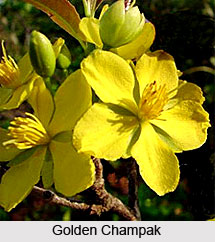
 Golden Champa, botanically known as Magnolia champaca, is an evergreen tree characterized by highly scented yellow flowers. The flowers find importance among various religious rituals. The cultivation of this tree is primarily done for timber. It is also very popularly used for urban landscaping. It is called as `Champa` and `Champaka` in both Bengali and Hindi languages. The name `Champaka` has been derived from the Sanskrit word `Champaka`. It is called `Chembuga` or `Chambugam` in Tamil and `Champaka` in Telugu.
Features of Golden Champa Tree
If provided with suitable conditions, Golden Champa tree can rise up to 30 metres in height. It needs plain land or low hills and sufficient rainfall to appear in its fullest glory. The tree never gets leafless. The leaves of this tree are a little similar with that of Mango tree. They are long and curvy-edged and also have a silky-smooth bloom before they open out. The scent of the flowers fills up a huge area surrounding the tree twice in a year during the months of May and October. The sepals and petals of the flower are of the same golden-yellow colour. They appear like twelve to fifteen slender, pointed petals. They usually grow in the axils of the leaves with curved stems and when in bud, they are covered by a pinkish-yellow sheath. There are some varieties of the flowers. One kind of them is white and creamy-white and another one is golden-orange in colour. These golden-orange coloured flowers are undoubtedly the most favoured variety being even more highly scented. The common Champa are able to produce plenty of seeds. In fact, the golden Champa tree becomes so much exhausted with the extravagance of its output that it takes another two to three years to gather enough strength to be able to flower again. The colour of the seeds is coral-red and each green, dotted carpel contains two or more seeds.
Uses of Golden Champa
The yellow-brown timber of the tree has some great values and it can be used for making almost anything from cabinet to firewood. The flowers of the tree are extensively used for worship. It is also planted as an ornamental tree. The tree has a large variety of uses in medicine as well. The concoctions obtained from the bark can make a good tonic and also can be utilized as a cure for coughs and rheumatism. The scented oil yielded from the flowers is considered to relieve eye troubles and gout.