Diseases in Ayurveda - Informative & researched article on Diseases in Ayurveda
 Indianetzone: Largest Free Encyclopedia of India with thousand of articlesAyurveda


in  
 Art & Culture|Entertainment|Health|Reference|Sports|Society|Travel
Forum  | Free E-magazine  | RSS Feeds  
Ayurveda : Ayurved in India |Ayurveda |Ayurvedic Pharmas in India |Ayurvedic Herbs |Kerala Ayurveda |History of Ayurveda |Development of Ayurveda |Diseases in Ayurveda |Ayurvedic Hospitals & Practitioners |Physiology of Ayurveda |Panchakarma |Keraliya Pancha Karma |Ayurvedic Tastes |Malas in Ayurveda |Elements of Ayurveda |Branches of Ayurveda |Ayurveda Medication |Seven dhatus in Ayurveda |Concepts of Ayurveda |Treatment in Ayurveda |Ayurvedic Diet |Indian Ayurvedic Spas |Tridosha System in Ayurveda |Origin of Ayurveda |Astrogenetics |Panchagavya |Tastes in Ayurveda |Ayurvedic Massage |Ayurvedic Skin Care |Asthanga Ayurveda |Panchabhuta in Ayurveda |Ayurvedic Recipes |Gurukul System of Ayurveda |Ayurvedic Practitioners in India |Ayurvedic Hospitals in India |Principles Of Ayurveda
Home > Health > Ayurveda > Diseases in Ayurveda
Diseases in Ayurveda
In Ayurveda, the fundamental cause of disease is the imbalance of the three doshas - Vata, Pitta and kapha.
More on Diseases in Ayurveda
  Ayurvedic concept of disease   Causative Factors of a Disease    

 Diseases in AyurvedaDisease is the state of body and mind in which a person experiences discomfort, pain and injury. The fundamental cause of disease is the imbalance of the three doshas - Vata, Pitta and kapha. When the three doshas are balanced the body experiences health and the state of imbalance or disequilibrium is disease. The imbalance may be due to an increase or decrease in one, two or all the three doshas. The classification of disease in Ayurveda is done in various ways.

Ayurvedic Concept of Disease
The Ayurvedic concept of disease explains pathological condition in terms of doshas, dhatus and malas. The Ayurvedic concept of disease defines two terms, vikruti and prakruti. Vikruti is the abnormal or diseased condition of the body while prakruti refers to the normal physiological and mental state.

Causative Factors of a Disease
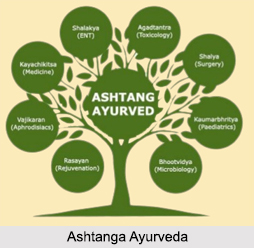
According to Ashtang Ayurveda, the causative factors of a disease are an imbalance in any or more of the three doshas (vata, pitta and kapha), the seven dhatus (rasa, rakta, mansa, meda, asthi, majja and shukra), agni and the three malas (mutra, purisha and sweda). The imbalance may be caused by the following conditions: "Asatmendriyarth Samyog", Aama, Pradnyaparadha and Parinama. "Asatmendriyarth Samyog" stands for improper or too much exploitation of the sense organs of vision, sound, smell, sense and touch.

Classification of disease in Ayurveda
One of the methods of classification of disease in Ayurveda is on the basis of the causative factors. Classified thus, we have three types of diseases: Adhyatmika diseases, Adhibhautika diseases and Adhidaivika diseases. Adhyatmika diseases have their source within the body, and may be further divided into hereditary diseases, congenital disease, and diseases caused by one or more of the doshas or body tissues. Adhibhautika diseases have their source outside the body and incorporate such things as injuries from accidents or mishaps, and according to modern terms, invasions by germs, viruses, and bacteria. Adhidaivika diseases are believed to spring from supernatural sources. This category includes diseases whose exact cause has not yet been found out. It includes ailments cropping up from providential causes, planetary influences, curses and seasonal changes. A more practical classification of disease convenient for treatment classifies the diseases into seven categories. Aadi- bala pravritta refers to those diseases that are transmitted through genes. Human beings are genetically predisposed to fall prey to such diseases. Janma- bala refers to those diseases that are present in the body from birth. Dosha -bala incorporates those diseases that affect the body when the body is suffering from an imbalance of the three doshas, vata, pitta and kapha. Under the category of Sanghata-bala fall those diseases, which are caused by trauma, both physical and mental. Kaala - bala refers to those diseases caused by seasonal changes. Daiva -bala signifies those diseases, which are caused by Gods or spirits. Svabhaava -bala incorporates those diseases that are a part of the natural change of the body with the passage of time. It includes aging and withering of the body.

Diseases in AyurvedaThe classification of disease can also be done as nija, agantuja, sharirik and manasik. Nija refers to endogenous diseases caused by disorder in the doshas. Agantuja stands for exogenous diseases that are caused by external reasons like injuries. Here too the imbalance of doshas does occur but only after the condition of the disease becomes pathological. The diseases caused by physiological disturbances are called sharirik diseases and those, which are a result of psychological disturbances, are known as manasik diseases. Ayurveda also gives the classification of disease according to their curative measures. Thus classified diseases can be Sukhasadhya, Kruchrasadhya, Yapya and Asadhya. Those diseases, which get cured very easily, are categorised under Sukhasadhya. Kruchrasadhya diseases take a lot of time to cure. Those diseases, which recur when the treatment is stopped, fall under the category of Yapya. Asadhya signifies those diseases that are incurable.

Thus, classification of disease is done in many ways in Ayurveda. Such an intensive classification system facilitates proper treatment of diseases.
Parinama in Ayurveda
Parinama refers to abrupt environmental changes, which makes the body vulnerable to disease.Parinama or kala also refers to the effects of time, and the natural physical transformation that are affected as time progresses. In short kala or parinama is defined as "being out of harmony with the rhythms and cycles of Nature". Ayurveda talks about several important cycles at a macrocosmic level, which in turn affects the physiological conditions of human beings.

Pradnyaparadha in Ayurveda
Pradnyaparadha is the improper use of intellect or wisdom that makes the body vulnerable to ailments.This means those thoughtless actions, which are undertaken without determining whether those actions will be detrimental to the proper functioning of the body. These actions may be verbal, mental or physical. The actions stimulated by pradnyaparadha worsen the tridosa system in the body and stimulates the gunas of rajas and tamas creating a pathway through which disease can enter the body.

(Last Updated on : 24/05/2013)
Recently Updated Articles in Ayurveda
Rasayana Tantra
A specialized branch of Ashtang Ayurved , advocates prevention rather than cure for achieving a long and healthy life.
Agada Tantra
Agada tantra is a branch of Ashtang Ayurveda that deals with the purgation of the body by removing poisons.
Stree Rogam and Prasuti Tantra
Stree Rogam and Prasuti Tantra are one of the most important parts of Ayurveda.
Shalya Tantra
Shalyatantra,a branch of Ashtang Ayurveda, deals with the various surgical techniques used to recover the body`s health.
Kayachikitsa
Kayachikitsa ensures complete treatment of the entire human body, by targeting the body as a whole.
E-mail this Article | Post a Comment
Forum
Forum on Ayurveda
Free E-magazine
Subscribe to Free E-Magazine on Health
 
 
Diseases in Ayurveda - Informative & researched article on Diseases in Ayurveda
Sitemap
Contact Us   |   RSS Feeds
Copyright © 2008 Jupiter Infomedia Ltd. All rights reserved including the right to reproduce the contents in whole or in part in any form or medium without the express written permission of
Jupiter Infomedia Ltd.