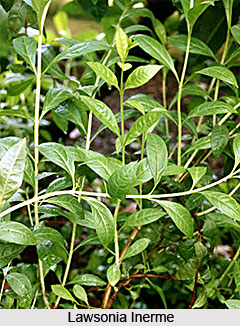
 Being one of the most common and most widely used amongst the Indian shrubs, the `Camphire Shrub` is known as `Lawsonia Inerme` to all the scientists of the world. The name `Lawsonia` honours the traveller John Lawson and `Inerme` means "unarmed" or in other words "thorn less". The Shrub derived from the family of `Lythraceae`. In the Hindi language, the Shrub is known as `Mehndi`. The Bengali name of the Shrub is also quite similar with the Hindi name. The name is `Mehdi`. The Tamil people call it as `Marudani` and `Mahthondi`. In Malayalam language, the name of the Shrub is `Mayilanchi` and in Telugu, people know it as `Gonnta`.
The Shrub is very much common in a lot of countries of the world. The Shrub has a great value as a cosmetic. The women in India tinge the palms of their hands, the tips of their fingers, the nails, and the soles of their feet with a paste of henna leaves. The process of making the henna is quite easy. The powdered leaves of the `Camphire Shrub` are compressed up with catechu paste and the dye that is made will endure for three or four weeks. This dye is a very popular form of beautification among the Indian women and also for many men from the North India. They like to give their hair and beard a copper tint. People can also dye skins and leather, with henna. However, the colour cannot be permanent, as the plant contains no tannin.
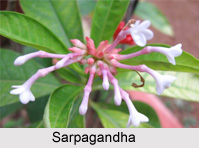
The `Camphire Shrub` is a soft and twiggy plant in the young age. At this time it also has some straight branches and several branchlets. It acquires a large amount of bristles and thorns when it becomes matured on poor soil or under inappropriate conditions. These bristles and thorns are often concealed in small, leafy side shoots. If you cut it well and constantly prune it, then it can make an ideal hedge as it become an almost impassable barrier. The pale creamy flowers have some long spires. These spires bear a deep, clinging fragrance and they are very suitable for cutting. The Shrub flowers all through the year, but during the Summer and the Rainy season, it achieves its best flowering period. The little and glossy buds of the Shrub open into tiny stars. A large number of projecting and yellow-tipped stamens give the sprays a soft, feathery effect. There is a variety of the Shrub that has dry and pale red coloured flowers and another of a clear pink colour.
The fruit of the Shrub is a little pea that contains many seeds. The fruits turned out in such a large amount that the branches of the Shrub bent down with the weight of the clusters. The fruits of the `Camphire Shrub` are of green colour and shining at the beginning and by the course of time, they become brown coloured, dry and hard. One cannot count the leaves of the Shrub. The leaves grow on short stalks from the red-brown branches, from the branchlets and from every little side shoot. They normally reach the height of 2.5 cm. People can obtain an extract from the flowers, leaves and young shoots of the Shrub and can use that in the treatment of leprosy. They can also attain perfumes from the flowers. Medical persons use the leaves as a remedy for skin diseases and ulcers and the leaves can make into an astringent gargle as well. People also employ the hard, close-grained wood in order to make such small articles as tent pegs and tools.