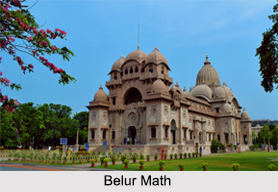
 Belur Math, established by Swami Vivekananda is located on the banks of the River Ganges in Kolkata. The temple exhibits a fine style of architecture that combines the elements from a church, a mosque and a temple. Swami Vivekananda, who was a religious reformer, was among the first disciples of Ramakrishna Paramahansa to set this up as the headquarters of the Ramakrishna Mission and Math. It is located in Howrah district of West Bengal. Belur Math is based on the ideologies of Sri Ramakrishna of seeking God in man by helping the poor and by providing spiritual help to the restless souls to get comfort at the time of distress.
The Ramakrishna Mission has been set up all over the world, and Belur Math is their headquarters. Belur Math was founded on the basis of a need for a permanent monastic base. Rather than religious atrocity what marks this temple and the architectural exploit is the spiritual essence throughout.
History of Belur Math
In January 1897, Swami Vivekananda arrived in Baranagar, Calcutta with his small group of Western disciples. Two monasteries were founded by him, one of them is at Belur, which became the headquarters of Ramakrishna Mission. The other place of worship was at Mayavati in Champawat District, Uttrakhand, which is called the Advaita Ashrama, presently, the Publication Centre of Belur Math. The design of the temple was envisioned by Swami Vivekananda and the architect was Swami Vijnanananda, a brother-monk of Swami Vivekananda and one of the monastic disciples of Ramakrishna. Swami Vijnanananda was a civil engineer in his pre-monastic life, designed the temple according to the ideas of Vivekananda and Swami Shivananda. He was the President of Belur Math at that time. Sri Ramakrishna Temple was consecrated on 14 January, the Makar Sankranti Day in 1938.
Architecture of Belur Math
Swami Vivekananda visited several architectural monuments like the Taj Mahal, Fatehpur Sikri palaces, Diwan-I-Khas, palaces of Rajasthan, ancient temples of Maharashtra, Gujarat, Karnataka, Tamil Nadu and other places during his parivrajaka days (wandering monk). Also, he came across buildings of architectural importance of Modern, Medieval, Gothic and Renaissance styles, while he was touring in Europe and America. The architecture of Belur Math clearly shows that Swamiji incorporated these ideas in the design of the Belur Math temple. The temple exhibits some of the finest styles in temple architecture; a trend that combined elements of a church, mosque and a temple.
Campus of Belur Math
The Belur Math campus area comprises of different temples and they are:
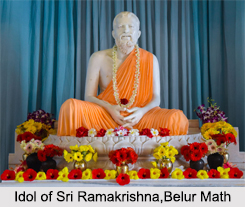
Sri Ramakrishna Paramahansa Statue: A full size statue of Sri Ramakrishna is seated on a lotus with hundred petals over a damaru shaped marble pedestal where the sacred relics of Sri Ramakrishna are preserved. The statue is separated by a transparent glass cover.
Sarada Devi Temple: A temple is dedicated to Holy Mother Sarada Devi; the temple is located right at the entrance of the Belur Math. The temple of Sarada Devi was made where she was cremated.
Old Temple: In this temple daily worship of Sri Ramakrishna Paramahansa used to be performed which is still there in the Belur Math campus.
Swami Vivekananda`s Temple: Swami Vivekananda`s temple is located adjacent to the Old Temple. The temple looks magnificent in size and splendor, and that too has been built where he was cremated.
Samadhi Peetha: This construction contains the `samadhi` of the seven foremost disciples of Sri Ramakrishna Paramahansa who were also cremated there itself.
Ramakrishna Museum: The Museum caters to the inquisitive needs of people who want to know about Ramakrishna and his teachings. Articles used by him are also displayed over there. There are several articles here that contain the preaching of this Indian saint.
Apart from these temples, the temple of Swami Brahmananda is also constructed in the Belur Math campus area.

Activities of Belur Math
The Math is an ideal place for reflection and spiritual regeneration. Studies of Vedanta form the primary concern among the monks. Vivekananda`s efforts of making Vedanta popular universally are still on and universities around the world have also got interested in the Math for further knowledge and information. The monks of Belur Math lead a disciplined life adept in the art of "Right Living & Right Action", which has been made obsolete by the modern day. Therefore, the Belur Math is an ideal destination for inner well-being and peace. The activities of the Math begin early in the morning with a `Mangalarati` at 4 am, followed by the Japa and meditation at the main temple. This ceremony is held only by the monks and is not open for the public. This routine is generally followed in the months of April to September. In the period between October and March the arati takes place at 4.30 am.
In the world of uncertainty and rush the peaceful locale provides an atmosphere to unwind in a spiritualistic way that has healing properties. Many people flock to the Math premises, which is in itself a wonderful specimen of art and architecture and upholder of a legacy carried through the years. It still functions but in a more Global fashion and many programs annually are being held which attracts people in large numbers. All Hindu festivals including birthdays of Sri Ramakrishna Paramahansa, Sri Sarada Devi, Swami Vivekananda and the first twelve disciples of Shri Ramakrishna Paramahansa are celebrated every year, along with the day when these souls ascended the heavenly abode. These days are marked by silent prayers, meditation and devotional songs sung by the monks. All these lend a special tint of solemnity to the Math, which has survived the ravages of time and transformations of civilisation.
 Festivals at Belur Math
The best time to explore the Belur Math is during the festivities like Durga Puja, Kali Puja and Ras Poornima celebrations at the month of September and October. However tourists also visit Belur Math between December and March and can participate in the celebration of Christmas, and the birthdays of Bhagavan Ramakrishna and Swami Vivekananda. They arrange a handicrafts fair and exhibitions and a firework show on Ganga River on the birthday of Bhagavan Ramakrishna.
Visiting Information
Belur Math can be reached by both river and railway. The math has its own Ferry-Ghat and Belur Math Station. The main entrance opens directly towards Grand Trunk Road. The math also has its own guest house and Prasad Bhavan.