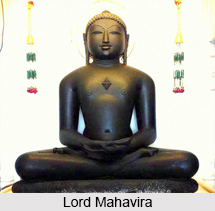
 Jainas could follow their religious practices undistributed even under many Mohammedan rulers. This was naturally to a greater degree the case in the independent or almost independent Hindu-states which were little affected by Islam, albeit the fact that the number and significance of the Tirthankaras had diminished considerably on account of their fights with the rivalling Shaivite and Vaishnavite sects. Inscriptions and buildings reveal that the royal patronage of the Jaina faith had not yet become extinct in South-West India. The two Gommata-statues erected by the believing rulers in two places in South Canara in imitation of the colossus of Sravana Belgola are a visible sign of the loyalty to the faith of Lord Mahavira`s religion: the one in Karkala by the prince Virapandya in the year 1432, and the other in Venur by Timmaraja in 1604. It is interesting to note that Jainism in Mysore had to fight Christianity in the midst of the 16th century.
Jainas got a great significance in that period, above all, in Central India and Rajaputana besides in their old home-state Gujarat. They had a great influence as businessmen and bankers in different princedoms of these regions, and they gave also excellent officers to the stale.
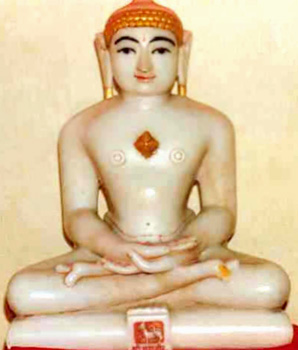
Testimony of the glory and riches of Jaina community are the works of art of the period, above all, the great figures of the Tirthankaras hewed out from the rock near Gwalior by the Tonvar-dynasty (1440-1473), the temples of Rakhabdev and Ranapur (both from the 15th century),the marvellous victory-towers in Rajaputana, etc. Favours shown by the princes of the Sisodiya dynasty are characteristic for the attitude shown by the Rajaputa Hindu-rulers towards them. Since years, Ranas of Mewar gave them their patronage and granted them many privileges. Jainas on their part showed that they were always the true servants of their masters. When Pratap Singh-I (1572-1597) was defeated by Emperor Akbar`s army and dissolved his fleeing army, a Jaina offered his riches to him to enable him to form a new army. He thus enabled the Rana to continue his march and get final victory the princes expressed their gratitude by giving Jainas all sorts of freedom. Thus Maharana Raj Singh issued an edict in 1693 by which he forbade killing of animals on the pieces of land belonging to Jainas and ordered that every living being entering the district of their holy places be protected, and besides, not only the animals which were taken to slaughter-houses, but also the criminals who had escaped from the arms of the law.
It is worth noting that Jainism got a foothold even in North India in the 15th century. It is said that King Narendracandra of Karigra who ruled around 1427 had become a Jain according to a Vijnapti which is recently published.