The customs, beliefs, practices, etc were quite different in the ancient Indian society. Ancient India witnessed the evolution of different civilisations. The remnants of the Indus Valley Civilization of Mohenjodaro and Harappa, dating back to the pre-Vedic period, are part of one such civilisation. The ancient Indian cities were well planned. The urban civilisation of Indus valley exposes brick-built houses, public baths, swimming pools, scientific system of drainage, well-constructed roads, terracotta work of various kinds, figures of human beings and deities, seals, etc. Some seals and stone images testify to the artistic skill of the people.
Literary Sources for Ancient Indian Society
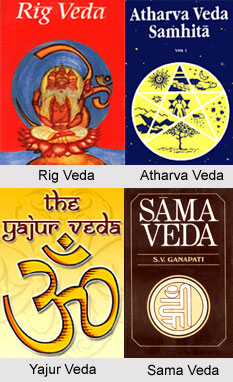
The evolution of the ancient Indian societies is well reflected in different literatures such as in Sanskrit literature and Indo Aryan literature. Further, besides works in Sanskrit, there are several Buddhist Pali works, particularly the Jatakas, and the Jaina works in Prakrit language and Apabhramsa that offer references of the ancient Indian societies. Moreover, the Rig-Veda is regarded as the earliest written record of the Indo-Europeans. Ancient Indian societies also get reflected in other Vedic Samhitas are the Yajur Veda, Sama Veda and Atharva Veda. Various prose, poetical and dramatic works reveal a society in which what actually happened and not what was ideal according to Smriti and other Shastras.
Religion in Ancient Indian Society
 While the Rig Veda contains Mantras mainly about the various aspects of nature, conceived as deities and the Yajur Veda contains matters for ritual application of the ancient societies. Atharva Veda contains matters reflecting popular beliefs and practices that were prevalent in the ancient societies. In it one can find the matters that were designed to prolong life, heal diseases, ward off evils, counteract the venom of snakes, cause mischief to enemies etc. Many amulets are mentioned; these are believed to ensure various kinds of welfare of the societies. A considerable role is played by Tantras in the social life of India. They give freedom to all, irrespective of caste, creed and sex, regarding religious rites and observances. They teach ways to liberation (mukti) through enjoyment, (bhukti). The ascetic practices of the Brahmanical religion are not favoured. The conventional Smriti rules are disregarded. For instance, even a low-class man, who has attained a high level of Tantric Sadhana, is to be saluted by a Brahmana. One`s mother is supposed to be one`s best spiritual guide. For Kumari puja, even a low-class girl of the requisite qualification can be selected by a Brahmana. Tantric ideas already appeared in the Atharva Veda. Some regard Tantra also as Sruti which is generally used to refer to the Veda. From the figures of mother-goddesses it seems that the Female Energy (Sakti) was considered to be the root of creation. Some stone chips seem to have been worshipped as Sivalingas (Phallus). It is supposed that trees, stones and animals etc. were worshipped. Serpent-worship was, perhaps, in vogue.
Buddhism was established in the 6th century BC as a protest against sacerdotal practices. It denied Vedic authority and dispensed with idle speculations on the existence of God. It laid greater stress on self-discipline and meditation, and advocated monk-hood and mendicancy. Instead of blind adherence to conventional ideas and practices, it preached a rational approach, and did away with the external formalities of religious life. Jainism arose about the same time. It carried the creed of non-violence much further, and considered the life of even an insect to be sacred. It preached the creed of rigorous ascetic practices to a limit that weaned away many people. It had much in common with Buddhism. Like the former it deified Vedic authority. Side by side with the orthodox religion, there were also atheistic ideas in the society. The Lokayata or the materialistic school, which traces its origin to `Carvaka`, did not recognise Vedic authority. The Brahmanical rites and practices were declared to be nonsensical, and designed by crafty Brahmanas to achieve selfish ends. It did not recognise anything which is beyond perception. The Samkhya philosophy declared that the existence of God cannot be proved.
Culture of Ancient Indian Society
 Of the ornaments, used in that age, the popular ones were necklace, ring, bangle, head-ornament, waist chain, earring, anklets, etc. Besides gold and silver, copper, bronze, ivory were used in jewellery. Among the implements for daily life were the axe, chisel, knife, sickle, hook (for catching fish), razor etc. For domestic work needles, spinning machines etc. were in use. Knife, mace, bow, arrow, etc. were defensive weapons. The relics contain toy carts, chains, dice, etc. Wheat, barley, and dates appear to have been widely used as food. Both cotton and woollen dresses were used.
Economy of Ancient Indian Societies
Agriculture played the most prominent role in economic life of the ancient Indian societies. Bull, sheep, buffalo, dogs, elephant, camel, etc. were the principal domestic animals. Chief craftsmen of the ancient era were potter, weaver, carpenter, mason, blacksmith, goldsmith, jeweller, ivory worker, stone-cutter, etc. Metal-work was also developed. There is also evidence of foreign trade. The main items of import were tin, copper and precious stones.
Caste System in Ancient Indian Societies
An analysis of the elements of the population reveals that the societies of ancient India comprised people of different castes. The main groups were Aryans or Indo-Aryans (upper class Hindus mostly speaking Sanskrit languages and Dravidians - they were mostly inhabiting South Peninsular India, differing from the Indo-Aryans and speaking Tamil, Telugu, Malayalam languages. There were primitive tribes like Kol caste, Bhil tribe and Munda tribe residing in hills and forests, speaking languages were absolutely different from those of the above two types.
The term `Mleccha` is often met with in different works. Generally it is taken to denote the people beyond the purview of the four castes of the ancient Indian societies. Several researches and surveys have been done on the ancient societies of India.