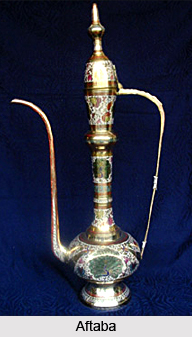
 Aftaba is generally known as Ewer in India. The use of aftaba or ewer had come to India with the entry of Islam in India, especially with the coming of Mughal rulers. Its shape generally consisted of a bulbous belly to contain liquid; a pedestal foot, often
circular in plan; a long spout, usually curved but sometimes straight; a tall neck; an arched handle, often embellished with a stylized dragon; and, finally, a stately cap reminiscent of the "pleasure domes" of Muslim buildings, serving to cover the vessel and protect its contents.
Aftaba is generally known as Ewer in India. The use of aftaba or ewer had come to India with the entry of Islam in India, especially with the coming of Mughal rulers. Its shape generally consisted of a bulbous belly to contain liquid; a pedestal foot, often
circular in plan; a long spout, usually curved but sometimes straight; a tall neck; an arched handle, often embellished with a stylized dragon; and, finally, a stately cap reminiscent of the "pleasure domes" of Muslim buildings, serving to cover the vessel and protect its contents.
In the hot climates of India and the Middle East, this water-bearing vessel had great importance. Water containers, whether in the guise of ewers, flower vases or flasks, became ubiquitous motifs in art and architecture in India from the times of the Mughal rulers. Images of ewers are often painted on Iranian ceramics from the earliest period down to the nineteenth century; they are depicted in Persian and Mughal paintings, in use or ostentatiously displayed on terraces. The niches in palace scenes usually contain flasks or ewers, and sometimes the niches themselves - not only as represented in art but also as they survive in buildings - are shaped like water vessels. Flower vases, especially in Safavid and Mughal times, were the commonest motifs for decorating wall surfaces: in Iran usually in tile work, and in India usually in stone relief or pietra dura inlaid into marble.
A number of ewers have survived from the Mughal times in India. The earliest Indian ewers can be dated only to the Sultanate period, the fourteenth and fifteenth centuries. Two large ewers are the only survivors of the great tradition of early Sultanate cast bronze vessels. The ewers which are present have an extravagantly arched handle and spout, which jauntily frame a deeply ridged belly with the bulging, mellonate shape of the Indian water pot or lota. The long neck of the aftaba resembles the Indian flower vase.
The features of the aftaba which are more common in India are the grooved body, the nearly vertical handle with horizontal notches, double spout. Although imported and indigenous forms, in architecture, began to influence each other in certain regions and social strata from the earliest days of the Muslim invasions of the twelfth century, most objects produced in the Sultanate period can still be classed as Hindu or Muslim, their shapes dependent on the religion of their patrons.
It is said that a more rustic ewer retains features of the Sultanate vessels, but with a greater tendency towards verticality. The combination of a tall thin neck, splayed at top and bottom, with a voluminous belly is characteristic of ewers from the Punjab plains and hills.
A saffron-yellow brass aftaba likewise retains rustic echoes from the Sultanate period, but its stronger horizontal lines, parrot-adorned handle and solar wheel device on the side place it in seventeenth-century western India, probably Rajasthan or Gujarat where similar solar shapes were common in the pierced stone window screens (jalis) of local palaces and mosques.
Historical record says that one of the most imposing of Mughal ewers, of unusually thick cast brass, has an elongated neck supporting a stately domed lid. It represents the extension into India of a type of aftaba more commonly associated with the Middle East. The commonest sort of Mughal aftaba - whether of brass, bidri or even glass - consists of a round or slightly pear-shaped belly, a curved handle and spout, a tall neck with a bulge or disk in the centre, and a crescent shaped top.
In conclusion it can be said that aftabas or ewers had come to India with the entry of the Mughals into the country but they slowly started developing a style which was essentially Indian. Rather it can be said that in the making of ewers there were more of artistic experimentation.