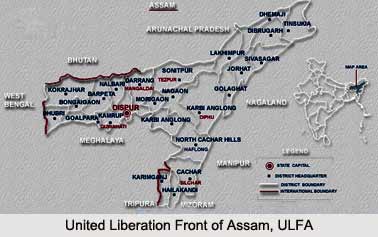
 United Liberation Front of Assam (ULFA) was formed originally by dissidents from the AASU and the All Assam Sangram Parishad. However, it came into the forefront only in 1990 after the failure of the AGP government to accomplish any of its goals.
While the AGP attempted to work out with the central government detailed plans for implementing the Assam Accord and revising the electoral rolls, United Liberation Front of Assam expressed its loss of faith in both the AGP and the central government by demanding secession from India and launching a violent movement to attain its aim, including bank robberies and killings.
Although both the AGP and AASU declared their opposition to secession, their capacity to deal competently with the ULFA movement was hampered. By the fact the ULFA was itself a successor of their own preceding movements. This made a challenging effort to them in their own strongholds with a similar appeal to Assamese Hindu resentments against the alleged loss of their territory to foreigners and their exploitation by the central government.
In November, 1990, the Government of India imposed President`s Rule on Assam and began military action under "Operation Bajrang" to hold back the insurrection and arrest and imprison ULFA activists. ULFA members fought back and killed ninety seven people, including twenty five Congress (I) members. The central government, then under Prime Minister Chandra Shekhar Singh and dependent on the support of the Congress, removed the governor of the state and extended President`s Rule.
ULFA called upon its members and supporters to keep away from participation in the May-June, 1991 legislative assembly and parliamentary elections in Assam, which opened the way for a Congress victory and its return to power in the state after a lapse of five years. ULFA leaders were apparently surprised by the victory of the Congress (I) in these elections. ULFA greeted the formation of the new Congress government on July 1st, 1991 with a dramatic arrest of fourteen hostages from different parts of the state. Negotiations followed after which five hostages were returned in exchange for twenty-six ULFA militants. However, negotiations broke down after, ULFA militants killed two of the hostages, and the Saikia government called the army back to the state to initiate on a major new attempt to break the militants, given the name, "Operation Rhino". By January, 1992, the ULFA movement appeared to have been broken and divided on the inside.
It is striking that the Congress (I) Government of Assam succeeded in confronting the ULFA rebellion and dividing it by following the methods used in similar situations in the 1960s during Jawaharlal Nehru`s time, especially in the Punjab. First, the government made completely clear that the secessionist goals of ULFA would not be considered and applied immense force to break it. Second, the government at the same time carried on negotiations with the aim of splitting off the moderates and isolating the extremists. Third, the state and central governments, both under Congress (I) leadership, consulted on a regular basis and acted in unison. It should also be noted also that the methods adopted were diverse from those practiced under Mrs. Indira Gandhi and Rajiv Gandhi as well in Punjab and Assam.