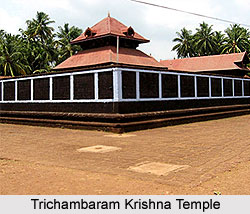
 Trichambaram Krishna Temple is one of the famous temples of Kerala. It is about two kilometres north-east of the Taliparamba Shiva temple. The temple is dedicated to Lord Krishna. The jubilant form of Lord Krishna after the killing of Kansa is depicted in all its splendour at the temple of Trichambaram.
Legend of Trichambaram Krishna Temple
According to a legend, the place where the temple is erected was once a big forest, and was known as Sambaravanam or Sambara forest. There was one Sambara Maharshi here, who by practising tapas for several years and propitiating Mahavishnu, attained oneness with the God. Henceforth people felt the divine presence here and their devotion and faith gradually gave shape to a temple. It is not known whether the temple came into existence in Dwapara Yuga or Kali Yuga. There is a general belief that this Vishnu temple was built soon after the Shiva temple at Taliparamba in order to temper the fierceness of Lord Shiva.
As in the case of several other temples in Kerala, Parasurama is also credited with the construction of this temple. When he came to Trichambaram he had the wonderful vision of the Lord after annihilating Kansa. After constructing the temple Parasurama laid down the pooja routine and stipulated the different festivals to be observed in the temple.
History of Trichambaram Krishna Temple
According to the Mushakavamsa which a historical mahakavya composed by Atula in the in Sanskrit language, narrates the history of Mushaka kingdom till the 11th century A.D. according to it King Valabha II is credited with having renovated the Vishnu temple at Trichambaram. This indicates that the temple had been in existence much earlier than the 11th century A.D.
Incidentally, Mushaka country (which later came to be known as Kolathunad, North Malabar, ruled by Kolattiris), had been ruled by illustrious kings like Vikrama Rama, Jayamani, Valabha II and Srikantha. It was Vikrama Rama who saved the famous shrine of Sri Mulavasam, the famous Buddhist shrine, from the havoc of sea erosion. King Valabha was also a generous patron of learning. It was he who built the port of Valabhapattana which later on got corrupted into Valayapattana and then into Valarpattana, i.e. the modern, Baliapattanam.
King Valabha was succeeded by his younger brother Srikantha who was also called Rajadharma. The poet Atula who composed the Mushakavamsa lived in his court.
Architecture of Trichambaram Krishna Temple
The temple of Trichambaram Krishna Temple has been well designed and decorated. The central shrine which faces east is perfectly square in plan and therefore of great antiquity. The temple holds a large image of Lord Krishna carved of stone and hung with metal ornaments. It can be seen in a halo of lights in the centre of double walled garbhagriha. The srikoil is meaningful and beautiful for its mysterious interior and exterior carvings below the roofs. The murals that date from the 15th and 16th centuries also adorn the beauty of the temple. These represent an early stage of surviving wall paintings in Kerala.
A little to the north of the main entrance to the temple there is a little pond of about 30 square feet at the centre of which there is a Durga shrine facing west. This tank is considered a holy teerth and hence no one is permitted to take bath in it. The water level remains always the same; it neither increases during the rainy season nor decreases during summer. At night it looks enchanting with the oil lamps lit around the temple reflected in its water.
Customs of Trichambaram Krishna Temple
There are two peculiar customs observed here, which reinforce the belief that the deity here represents the Lord after Kansavadha. One is the offering of naivedya immediately after the sanctum is opened for the day every morning. The belief is Krishna after killing Kansa went to his mother Devaki and asked for food stating that he was very hungry after the ordeal. It is to commemorate this event that the ritual of offering food the first thing in the morning` is observed.
The other is the prohibition of elephants being taken anywhere near the temple. It may be recalled that the royal elephant Kuvalayapida charged Krishna and Balarama while they were entering the palace of Kansa. Since this incident Krishna had developed hatred against elephants. For this reason no one dares taking an elephant near the temple although elephants are very much part of all other Kerala temples where the deities are mostly carried atop these animals in procession.
Festivals of Trichambaram Krishna Temple
The annual festival at Trichambaram is in the month of March. It starts with the flag-hoisting ceremony on 22 of the Malayalam month of Kumbha. The same night the Balarama deity from Dharamkulangara (Mazhur) six km. away is brought in procession. As already mentioned there is no elephant for the procession. The images of both Krishna and Balarama are carried on the head by priests who dance to the accompaniment of drums. The nrittam or dance takes place at night daily up to the 2nd of Meenam month at Pookothunada, a place on the main road about 2 furlongs from Trichambaram temple.
The divine dance lasts till the morning delighting hundreds who flock to see the festival. The pallivetta, the Lord`s hunt, takes place on the 4th of Meenam and the arattu, bathing ceremony, on the 5th. On the 6th the famous farewell takes place between the brothers which provide a grand finale to the 15 day festival. The event which takes place in a maidan near the temple attracts hundreds of thousands of people from far and near.