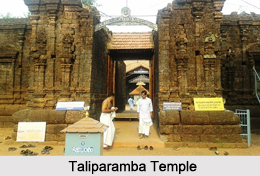
 The Taliparamba temple is among the 108 ancient Kerala temples dedicated to Lord Shiva. It was earlier said that pregnant women should visit all the temples of Lord Shiva here and others located at Vaikom Shiva temple, Ettumanur temple and Vadakkunnathan temple at Trichur. It was believed that the Lord of Taliparamba assured that the child born to the women who worship him will attain a high status.
Legend of Taliparamba Temple
The Shivalinga here is believed to be thousands of years old. Legend has it that Lord Shiva gave three sacred Shivalingas to Parvati for worship. Once sage Maandhata propitiated Lord Shiva with intense prayers. Shiva was so pleased that he presented one of the Shivalingas to him with the injunction that it should be installed only at a place where there was no cremation ground. The sage, after searching all over, found Taliparamba the most sacred spot where he installed the linga.
After his death the linga however disappeared into the earth. Then his son Muchukunda offered similar prayers to Shiva and got a second linga which too disappeared in course of time. Centuries passed. The third Shivalinga was handed down to Satasoman, a king of Mushaka (Kolathunad) dynasty who then ruled the region. He was an ardent devotee of Shiva. On the advice of sage Agastya he prayed to Lord Shiva who granted him the Shivalinga. The king installed it in the present temple built by him.
Architecture of Taliparamba Temple
The central of Taliparamba Temple shrine is an ancient quadrangular structure surmounted by two roofs one ending at the lower level and the top one resting on walls rising from the lower roof. The whole edifice has a pyramidal roof. Parallel to the central shrine and in front of it is the namaskara mandapa with sloped roofs and two projecting gables at either end. The main building has only one stupi and the namaskara mandapa three.
The balikkal has no roof but is embellished by a mysterious figure with a peculiar face. In front of the balikkal is a small rectangular building with a pyramidal roof, which is not usually found anywhere else. There is no flagstaff. An inscription on the structure of the temple tank (which is a little away from the temple on the north side) indicates that the temple and the tank were renovated in 1524 A.D.
The Shiva linga of Taliparamba temple is only about three feet in height but when decorated with the luminous crescent i.e. with the three eyes which are quite large and prominent and the nose all made in gold the idol looks much taller and bigger.
Offerings of the Taliparamba Temple
The main offering here is naiamrithu or ghee, made available to devotees in small pots for a rupee each. The ghee offered is used for abhisheka and for lighting the lamps in the central shrine. On auspicious days like Mondays, pradosham etc., hundreds of such small naiamrithu pots can be seen placed before the deity. Shivaratri and Vishu are the two main annual festivals celebrated here, each lasting a day, not several days like utsavams in other Kerala temples.
A peculiarity here is that women devotees are not allowed to enter the temple during day time; they can enter and worship only after athazha (night) pooja. At this time the Lord is supposed to be happy in the company of his consort, Parvati, and pleased to grant the desires of His devotees who pray to Him with humility and sincerity.