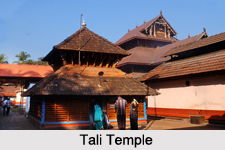
Tali Temple, Kozhikode, Kerala - Informative & researched article on Tali Temple, Kozhikode, Kerala
  Indianetzone: Largest Free Encyclopedia of India with thousand of articles Indian Temples


in  
Art & Culture | Entertainment | Health | Reference | Sports | Society | Travel
Forum  | Free E-magazine
Indian Temples : Indian Temples l Arts and Crafts of Hindu Temples l Indian Religious Temples l Churches in India l Mosques in India l Shiva Temples In India l Krishna Temples in India l Hanuman Temples in India l Durga Temples in India l Vishnu Temples in India l North Indian Temples l Central India Temples l West India Temples l East India Temples l Indian Regional Temples l Indian Temple Managements l Styles of Worship in Indian Temples l Indian Temple Architecture l Indian Temples by Religion l History of Indian Temples l Hindu temples in India l Gurudwaras in India
Home > Reference > Indian Temples > Indian Regional Temples > South Indian Temples > Temples of Kerala > Tali Temple
Tali Temple, Kozhikode, Kerala
Tali Temple of Kerala is historically famous. The temple gives an impression of the old Kerala during the times of the Zamorins.

Tali Temple, Kozhikode, KeralaThe Tali temple at Calicut (Kozhikode) is redolent of some of the glorious chapters in the history of old Kerala. It reminds you of the life and polity of the State in days gone by and of the glory of the great Zamorins who were among the most cultured and accomplished sovereigns of Kerala. Tali is a term generally applied to a Shiva temple and, like all Kerala temples, Kozhikode Tali was an independent sanctuary which belonged to Brahmins. In those days Kerala consisted of a number of temple-states and village republics belonging to Brahmins. In the temple-state the Lord was regarded as the head and everything was done in his name. The territory under their rule was called a sanketam.

History of Tali Temple
The Zamorins was closely associated with three temples; Tiruvalayanad, Tirunavayi and Kozhikode Tali. Their empire dates back to the installation of Porkhali Bhagawati at Tiruvalayanad. The Mamamkam at Tirunavayi was a twelve-yearly demonstration of thair imperial pomp and pageant. The annual Revati Pattattanam at Tali was a seven-day feast of learning, comparable to the Vid-vasadas of Janaka of Videha.

The Zamorin naturally flew into a rage and seized the Tali temple, by force in spite of the resistance of the Nambudiris who in those days were also doughty warriors. Many were killed by the Zamorin`s men and their bodies were dragged and thrown on the mound now called Surgam (Durgam) nearby.

Some gramams were also administered by kazha-kams or Advisory Boards, each under an officer called the Taliatiri. These villages were known as Talis, of which the important ones numbered eighteen. Among them Kozhikode Tali was the most famous.

However this Tali was not founded by the Zamorin. As stated earlier, it belonged to fifty Nambudiri families of the Tali gramam. They also ran a Vedic pathasala or school at Salapuram, now called Chalapuram. They maintained intimate and cordial relations with their ruler, Porlatiri, the men even having sambandham or liaison with the thampurattis or princesses of the royal family.

Their territory was besieged and invaded by the Zamorin some time about A. D. 1200. With the occupation of Calicut by the Zamorin, Porlatiri was expelled from his land. Naturally, the Nambudiris of Tali did not like this and were very unhappy.

vishu festival The Kofattiris of Chirakkal were the allies of Porlatiri and the enemies of the Zamorin. The story goes that the Tali Nambudiris helped a Kolattiri prince to smuggle himself into the Zamorin`s palace in the guise of a Brahmin. A Thampuratti fell in love with him. And when the romance could no longer be concealed, the lovers fled, with the connivance of the Nambudiris.

According to another version, the Brahmins resorted to pattini or fast unto death seating them on the top of the Surgam. The Zamorin was however firm. They had helped his enemy and they brought dishonour on the royal family, making the sovereign a laughing-stock of all Kerala. He refused to submit to what he regarded as pure political blackmail, however holy or high its authors might be. Thus the misguided Brahmins were allowed to die.

The temple did not suffer in any way by the change in management. But the death of the Brahmins cast its dismal shadow. The palace astrologers found an easy explanation for any anishtam or unpleasant event in the Zamorin`s family from common cold to natural bereavement and insisted upon the expiation of this sin of Brahmahatya or slaughter of Brahmins. At last on the advice of Kolkunnathu Sivankal, the Zamorin instituted the annual Pattattanam in A.D.1309-1310 at the Tali temple.

Festivals of Tali Temple
There are five poojas every day here and three sivelis or processions of the deity. Namajapam or repeating of the Lord`s names is also conducted daily in the evenings as also Bhagavata saptaham annually. The annual utsavam begins on Vishu day (Kerala New Year`s day) and lasts for 7 days. On the 8th day the arattu or bathing ceremony is held.

The pattini is said to have taken place in the month of Thulam (October-November) and it lasted for seven days from Revati or the twenty-eighth asterism to Thiru-vatira, the sixth asterism, when the last of the Nambudiris who fasted passed away.

It consisted of a feast for seven days corresponding to the duration of the fast, from Revati in Thulam to the following Thiruvatira, at the end of which the Bhattas or Brahmins, learned in the smritis and sastras, were each given a purse containing 101 fanams, which was equivalent to 360 paras or measures of paddy and which was enough to maintain one in all decency. This was a sort of annual pension and once granted it could be received by proxy on the principal`s behalf.

Renovations of Tali Temple
The present temple was built by Manavikraman the great. Like several other temples in Kerala the Tali temple also, which was subjected to spoliation and desecration by Tipu Sultan, had been renovated at the close of the 18th century. Following a devaprasnam conducted in 1964 renovation work was again taken up and completed in 1967 with a navikarana kalasam or purificatory rites performed on an elaborate scale. Then the installation of flag staffs had taken place for both the Shiva and Krishna shrines on March 3, 1976. In the following year, a Rig Veda laksharchana was also conducted to commemorate the historic Revati Pattattanam which, alas, now belongs to history.
(Last Updated on : 21/06/2010)
  More Articles in Temples of Kerala
 
Chirakkadavu Mahadeva Temple Shiva Temple of Ernakulam & Ettumanoor Temples in Thiruvananthapuram
Temples around Thiruvananthapuram Temples in Sabarimala Bhagawathi Temple
Temples in Munnar Temples of Kottayam District Thrissur Temples
Alappuzha Temples Ernakulam Temples Guruvayur Temples
Temples in Kasaragod District Vadakkunathan Temple Features of Kerala Temples
Padmanabhaswami Temple Serpent Temple of Kerala Aranmula Parthasarathi Krishna Temple
Ambalapuzha Krishna Temple Ettamanur Temple Vaikom Shiva Temple
Chhotanikara Temple Bhagawati Temple Temple of Bharata
Sri Rama Temple of Triprayar Vadakkunnathan Temple Trichambaram Krishna Temple
Tiruvangad Perumal Temple Tali Temple Taliparamba Temple
Sree Janardana Swamy Temple Sree Subrahmanya Swamy Temple Kumaranalloor Temple
Udayanapuram Temple Temple for Rama and Lakshmana Chettikulangara Bhagavathi Temple
Thirumanthamkunnu Temple Panayannarkavu Temple Thonnallur Pattupurakkavu Bhagavathi Temple
Mannarasala Sree Nagaraja Temple in Kerala Oachira Temple  
Recently Updated Articles in Indian Temples
  • Temples of West Bengal
    Temples of West Bengal attract a number of pilgrims throughout the year, especially the Kalighat and Bishnupur group of temples.
  •  
  • ISKCON Mayapur
    ISKCON Mayapur is a famous pilgrimage spot and is one of the popular places in the Nadia District in West Bengal.
  •  
     
  • Our Lady of Snow Church
    Our Lady of Snow is a Roman Catholic Marian church in Kallikulam, Tirunelveli district of Tamil Nadu.
  •  
  • Poondi Madha Basilica
    Poondi Madha Basilica or Our Lady of Lourdes Basilica is a Catholic pilgrimage centre that is located in Tamil Nadu.
  •  
  • Basilica of Our Lady of Good Health
    Basilica of Our Lady of Good Health is located at the small town of Velankanni in Tamil Nadu.
  •  
    E-mail this Article | Post a Comment
    RSS Feeds
    Forum
    Forum on Indian Temples

    Free E-magazine
    Subscribe to Free
    E-Magazine on Indian Crafts
     
     
    Tali Temple, Kozhikode, Kerala - Informative & researched article on Tali Temple, Kozhikode, Kerala
    Sitemap
    Contact Us   |   RSS Feeds
    Copyright © 2008 Jupiter Infomedia Pvt. Ltd. All rights reserved including the right to reproduce the contents in whole or in part in any form or medium without the express written permission of Jupiter Infomedia Pvt. Ltd.