


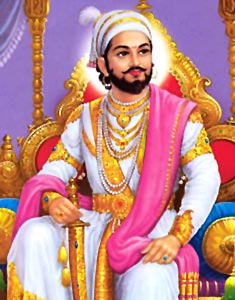
 Reign of Shivaji was one of peace and prosperity. Shivaji Maharaj, the crowned king of the Marathas was different from Shivaji the rebel, fighting to liberate tracts of land from the rule of the Muslim overlords. With his newly acquired position, he assumed the responsibilities of a ruler and he performed his duties with much composure and confidence on throne. From the time of his coronation there were only six years to go before Shivaji died, during which there were renewed wars with Bijapur and the Mughal lasting from 1674 to 1676, and then came the campaign in the Karnatak against Venkoji, his step-brother, which lasted another two years from 1676 to 1678. The first two years may be described as years of consolidation of his position with mopping up operations to stabilise his hold over his kingdom. The campaign in the Karnatak was purely because Shivaji felt that he was entitled to half the jagir of his father. Reign of Shivaji was one of peace and prosperity. Shivaji Maharaj, the crowned king of the Marathas was different from Shivaji the rebel, fighting to liberate tracts of land from the rule of the Muslim overlords. With his newly acquired position, he assumed the responsibilities of a ruler and he performed his duties with much composure and confidence on throne. From the time of his coronation there were only six years to go before Shivaji died, during which there were renewed wars with Bijapur and the Mughal lasting from 1674 to 1676, and then came the campaign in the Karnatak against Venkoji, his step-brother, which lasted another two years from 1676 to 1678. The first two years may be described as years of consolidation of his position with mopping up operations to stabilise his hold over his kingdom. The campaign in the Karnatak was purely because Shivaji felt that he was entitled to half the jagir of his father.
Shivaji as an administrator was extremely competent. He divided the work of government into eight ministries or departments. In this respect he was not very different from other earlier rulers, here and elsewhere, but there was in his government an element of decentralisation. He gave responsibility to his trusted men. It was the amount of trust which he put in all men who worked for him that gave them the opportunity to discharge the loyalty they owed him. All the different officials were very well aware of the responsibilities that were allotted to them and they conformed to the code of behaviour that had been set down for them. Any kind of embezzlement of public spoils was summarily dealt with. Shivaji did not encourage his subordinates to talk behind each other's backs. No one who was close to him or privileged to have access to his ear could whisper slanders about any others who worked for him. If an allegation had to be made, it had to be made publicly, and if necessary it had to be proved. In this way, by showing his confidence in the men who worked for him, he gave to the men concerned a sense of stability and confidence in his justice. In terms of the moral code, a number of regulations were made by him. No females, servant-maids or prostitutes were permitted to accompany any soldier on a campaign. Distillers or vendors or spirituous liquors were also prohibited from joining the regiment on March. An infringement of these rules was punished with death. Brahmins seemed to have special dispensation under Shivaji. They were not allowed to be interfered with by his troops on any campaign. Similarly, women and peasants were to be left alone. In the case of the wealthy, whether they were Muslims or Hindus dependant on a Muslim ruler, his soldiers were allowed to arrest them and extort money from them in accordance with their respective wealth, but once this 'tax', as it was called, was levied, they were to be set free and not harassed any more. He made grants of money to both Muslim shrines as well as to Hindu temples. Such grants as had been made to these holy places over a long period of time, Shivaji not only continued but, when necessary for the upkeep of a holy place, he augmented. Often he ceded agricultural lands to these religious institutions so that out of the revenues, these places of religious importance could be maintained for all time. It was this respect which Shivaji showed for all holy places, irrespective of the community to which they belonged, that sustained him in some of his most difficult times. He remembered that his predecessors had made vows at the shrines of Muslim saints and when the benefits prayed for, occurred, the vows made had been kept. His own father, Shahaji, was born because of a prayer at a Muslim shrine and he kept the Muslim shrines sacrosanct despite his territorial wars with the Muslim rulers. The overall picture of Shivaji in power was that he exercised religious tolerance even towards those, with whom he was at war. In that respect he came closest to Akbar and, as it has been said earlier in this book, had Akbar and Shivaji been contemporaries, the history of India might have been very different. |
| |||



Home > Reference > History of India > Medieval History of India > Maratha Empire > Shivaji > Reign of Shivaji
Reign of Shivaji
| Reign of Shivaji was one of peace and he was of an extremely unbiased disposition. He was an able ruler and sought to keep his people and his officials well looked after. |
| ||||||||||||||||||||||||||||

