


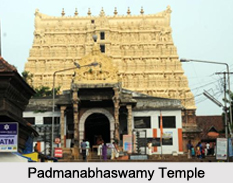
 The Padmanabhaswami temple is one of the main temples located in Thiruvananthapuram, the capital of Kerala. Thiruvananthapuram itself derives its name from Tiru-Ananta-puram, which means the place of the sacred serpent, Ananta or Adi-sesha on which the Lord Padmanabha reclines. The temple stands on an elevated part of the town and with its lofty eastern gopuram rising seven storeys high with a curious pagoda effect at its peak. The Padmanabhaswami temple is one of the main temples located in Thiruvananthapuram, the capital of Kerala. Thiruvananthapuram itself derives its name from Tiru-Ananta-puram, which means the place of the sacred serpent, Ananta or Adi-sesha on which the Lord Padmanabha reclines. The temple stands on an elevated part of the town and with its lofty eastern gopuram rising seven storeys high with a curious pagoda effect at its peak.
Padmanabhaswami temple is architecturally the most notable of temples in Kerala with both the indigenous style and the features of Dravida style architecture harmoniously blended. It is believed that the temple was built in 3000 B.C. An engraved inscription in Sanskrit and Malayalam characters on the base of the mandapa inside reveals that the temple was reconstructed from the Vimana down and the work had started in 1729 A.D. The mandapa was also used for feeding a large number of Brahmins every day. At the four points of this oblong corridor, but not connected with it, stand four stone platforms, from which people witness the God's procession during the important festivals in the temple. The temple stands on an elevated part of the town. It encloses an area of 25,700 sq. feet or about 7 acres. It faces east and is surrounded by massive fort walls. A handsome flight of stone steps on the eastern side shows the gentle eminence of the temple site, the front portion of which is covered by a huge gopura or tower pyramidal in shape and it is built of granite and brick on the model of the lofty gopuras towards the east coast temples. Legend of Padmanabhaswami Temple According to the legend of Sri Padmanabha Temple it was established by a Tulu Brahmin hermit named Divakara Muni on the 950th day of Kaliyuga. Divakara Muni was a Divakara Muni was a great devotee of Lord Vishnu. One day he was doing penance and tapas Lord Vishnu appeared before him in the form of a beautiful child. The sage fell in love with the child. The child said that it would stay only he was never scolded. One day due to some reason the sage scolded him and the child went away. The saint searched him in Anantankadii, the forest of Ananta where he got the vision of Lord Vishnu. Administration of Padmanabhaswami Temple The Padmanabhaswami Temple is owned by the erstwhile princely family. Due to the changed circumstances, changes in expenditure and external paraphernalia and trappings and in the hereditary duties and functions of temple staff were imposed. However, the daily rites, rituals and duties are still conducted strictly according to the sayings of the shastras. According to history says that members of the princely family have been traditionally devotees of the Lord Padmanabha. Umayamma Rani, the grandmother of Marthanda Varma during her reign (1677-84) saw to it that the daily rites and festivals of the temple were properly conducted. While she stayed at the capital she would go every day to the shrine to make her obeisance and never took her food before the noonday worship. And it is on record that once she had to forgo it altogether as, for some reasons; the noonday worship could not be performed. The tradition continues even today. Sculpture of Padmanabhaswami Temple Sculpture of Padmanabhaswami Temple has preserved some of the best traditions of stone sculpture in Kerala. The Kulasekhara mandapa in particular is the storehouse of some of the best pieces of sculpture and contains representations of various deities, especially of Lord Vishnu and Lord Shiva. The figure of Vishnu is a fine example of statuary art. It is in a sitting posture with Goddess Lakshmi on the left. The temple has a magnificent corridor. Beyond the corridor lies the wonderful flagstaff in gold holding at the top Garuda, the God's favourite riding bird. The stone basement of the tower is covered with elaborate sculptures. The outside walls of the central shrine are covered with mural paintings. Another interesting seated image is that of Vighneswara i.e. Lord Ganesha with his portly belly and stout diminutive limbs. On his sides stand three Brahmin priests performing puja. Festivals of Padmanabhaswami Temple There are mainly two festivals of Padmanabhaswami Temple, one in the month of Meenam (March-April) and the other in Thulam (September-October). Both are 10 day festivals that begin with the inaugural flag hoisting (Kodiyettam) ceremony on the first day, the Pallivetta (hunting) ceremony and procession on the 9th day and the arattu, the ritual bathing of the deities on the 10th day. |
| |||



Home > Reference > Indian Temples > Indian Regional Temples > South Indian Temples > Temples of Kerala > Padmanabhaswami Temple
Padmanabhaswami Temple
| Padmanabhaswami Temple is a famous temple located in the state of Kerala. The temple has been magnificently designed and is visited by many devotees from various places. |
| ||||||||||||||||||||||||||||

