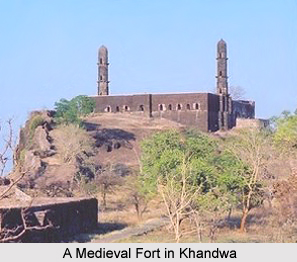
 Khandwa (East Nimar) district is situated in the southwestern parts of the Indian state of Madhya Pradesh. The surrounding districts of the Khandwa (East Nimar) district are Khargone district, Betul district, Dewas district, Burhanpur district (Divided from Khandwa District on 15th of August 2003). This district is famous for Omkareshwar (one among the twelve jyotirlingas). The District is in the Indore division of Madhya Pradesh. The maximum and minimum height of the district above mean sea level is 905.56 meters and 180.00 meters respectively.
History of Khandwa (East Nimar) District
Prior to the States reorganization, i.e., on the 1st of November 1956, this district was officially known as Nimar District and formed part of Mahakoshal region of the erstwhile Madhya Pradesh state. The western part of old Prant Nimar originally held by the Holkars, became a part of Madhya Bharat, when that state was formed in the year 1948. As on the reorganization of States, Madhya Bharat region was merged in Madhya Pradesh, the western part of old Prant Nimar eventually became a part of Madhya Pradesh. This tract with its headquarters at Khargore, also happened to retain its old name of Nimar, and being to the west of the district of former Nimar of Mahakoshal region, was named as Nimar (West) or West Nimar, while the district was officially renamed as Nimar (East) or East Nimar from 1st November, 1956. On 15th of August 2003, the district has been divided into Khandwa and Burhanpur district. The history of Khandwa (East Nimar) district is divided into ancient, medieval and modern periods.
Geography of Khandwa (East Nimar) District
 Khandwa district is located to the South-West of the state of Madhya Pradesh in India. The Khandwa (East Nimar) district is in Indore division of Madhya Pradesh. The maximum and minimum height above mean sea level is 905.56 meters and 180.00 meters respectively. The district forms its borders with the Betul district and the Hoshangabad district of Hoshangabad division to the East, Burhanpur district of Indore division to the South, West Nimar District of Indore division to the West, and Dewas district of the Indore division to the North.
The total area covered by this district is 6206.45 square kilometers. The climate of this district is pleasant and healthy. The district`s area falls in the drier parts of India. The average annual rainfall experienced in the district is 980.75 millimetres. The northern part of the Khandwa (East Nimar) district receives more rainfall than the southern part. The monsoon season starts approximately by the 10th of June every year and extends up to early October with quite humid days. The maximum temperature recorded in the month of May is 42 degrees Celsius and minimum temperature recorded in the month of December is 10 degrees Celsius.
Demography of Khandwa (East Nimar) District
According to the 2011 Population Census in India, the Khandwa (East Nimar) District has a population of 1,309,443. This district ranks 374 th in India out of a total of 640 districts. The district has a population density of 178 inhabitants per square kilometre. This district had a sex ratio of 944 females for every 1000 males. The literacy rate in this region is 67.53%.
 Culture of Khandwa (East Nimar) District
Major parts of the population of Khandwa (East Nimar) district are the Hindus, Muslims, Sikhs and Sindhis. Hindus comprise about 80 percent of the total population of the district. Mainly Rajputs, Kunbi and Gujjar and Marathas form the agricultural and social structure and construct the rural mass. Jains, Banias, Muslims, Sikhs and Sindhis mainly prefer to live in urban areas and form the trade oriented non-agricultural social structure. The Korku tribe, Bhil tribe and Gond tribe are major scheduled tribes live in the forest areas. The rich cultural heritage of communal dances is still preserved by the Rajputs, Gujjars, Korkus, Naagar Brahmins and Banjara tribe. The dance of the Rajput male is known as Gair dance and Kimadi while their female-folk is called Khada. Among the Gujjars, the male folk perform dip dance. The favourite male dance of Korkus is Susur, whereas Gadolia is female-folk of the same. The female folk dance of Gujarati community is known as Garba and those of the Nimars is known as Kathi. The Ramlila and Gammat are the favourite pastimes of the rural mass.
Tourism of Khandwa (East Nimar) District
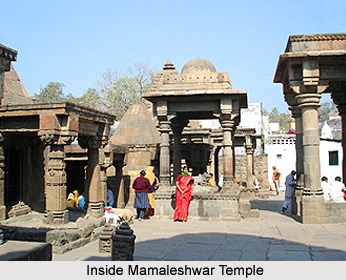
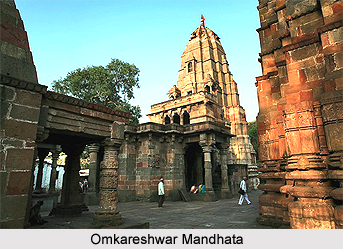
The town Khandwa is the headquarters of the Khandwa (East Nimar) district. The location, easy availability of resources and other socio-economic factors are in favour of making the place a very good industrial region. The district possesses several ancient kunds(Ponds), English architecture and religious places. Omkareshwar Mandhata is located on the bank of Narmada River, about 75 kilometers from Khandwa on Indore-Khandwa Highway. This is a holy place for Hindus and Jain Sects. Mamaleshwar temple, one among the 12 Jyotirlingas of Hindu sect and Siddhawar Kut of Jain sect are located at this place. Millions of the pilgrims of both sects as well as foreigners visit this place every year. Another attraction of this place is the cave of Adi Guru Shankaracharya, who was an ancient Indian Philosopher and social reformer of Hinduism.
Apart from these there are various other places of interest in the district of Khandwa (East Nimar) which include Ghantaghar or Clock Tower, Dada Dhuni Wale Darbar, Nav Chandi Devi Dham, Indira Sagar Dam at Narmada Nagar near Punasa, Nagchun Dam, Turja Bhavani Mata temple, Gauri Kunja, etc.