 Whilst discussing the birth of Shivaji one requires to delve a bit into the history of the Marathas. In this line in the year 1533, a pious man called Babaji was born to one of the Hindu families in the Konkan area which specialised in the art of war. By caste, being warriors, the early Marathas were Kshatriyas and claimed their origin from a Rajput warrior, Devraj Maharana, who brought his family from Rajputana into this area of hills and forests, the Konkan. In time the families grew and prominent in the fashionable Satara district there soon came the Naik Nimbalkars of Phaltan, the Deshmukhs and the Bhonsles. But fortunes changed from time to time; so did the power and the influence of the families which controlled these large tracts of land over which they ruled supreme. Muslim power at first did not consider this Konkan region important enough to annex and the ground was laid for small pockets of Hindu families who formed the nucleus of Maratha power. Devraj Maharana however found it difficult to stay in the slice of the Konkan. Mohammedan rule in the nearby areas of the Deccan made his position precarious. Constant clashes with the better equipped Muslim forces exhausted him till eventually he contented himself with the Patelship of Signnapur, which meant nothing more than that he was the head of the village. That was the line of Shivaji`s descent.
To Babaji were born two sons, Maloji in 1550 and Vithoji in 1553. These two boys went over to enlist themselves as infantry soldiers in the service of Lukhuji Jadhav, the Hindu Deshmukh of Sindkhed, an area within the Nizam Shah`s Dominion of Ahmednagar. Maloji was married to a sister of Nimbalkar, his former master. However for a long time after marriage he was issueless, whereas his brother Vithoji had been blessed with eight sons. Thus Maloji`s wife made endless vows to numerous deities in her prayers for a male child. But for a long time the gods did not hear her prayers. At last she made a vow at the shrine of a Muslim saint, Shah Shariff who was buried in Nagar. They were blessed with two sons and they named their first born Shahaji and their second Sharifji.
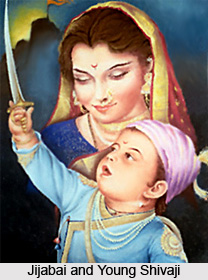 Shahaji went on to marry the daughter of Jadhavrao, Jijabai. Subsequently, there ensued a fight between the Marathas to decide whether the Mughals from Delhi or the local Sultan should rule over them in the Deccan, and the circumstances were such that Jadhavrao was left fighting and pursuing his own son-in-law, Shahaji who had been defending the Sultanate of Ahmednagar. While this fight between the two went on and Jadhavrao chased his son-in-law out of fort after fort, Jijabai, his wife, chose to follow her husband rather than seek protection from her father. With her during this time was her elder son Sambhaji and she carried in her womb the child Shivaji who was yet to be born.
At Shivneri, the famous hill fort, Jijabai halted in her flight. The local Hindu chief Shrinivasrao offered asylum to Shahaji`s pregnant wife while Shahaji fled to take up a safer position. Shivneri was thus destined to become the birthplace of her second son, Shivaji. Shahaji deputed three officers of whose loyalty he was sure, to guard over his pregnant wife. Protection was also accorded to her by Lukhuji Jadhav who was concerned about his daughter`s safety.
As in the olden days when each village and certainly each fortress had its guardian angel in the shape of a Hindu divinity, Shivneri was believed to be guarded by the goddess Shivai. To her, Jijabai prayed for her protection and for the delivery of her second child. She is known to have made a vow to the Goddess Shivai that is she were blessed with a second son she would name him after the Goddess. Jijabai`s prayer was answered and she named her new born, Shivaji.
Shivaji is said to have born in the year 1630 on February 19. His birth in the fortress of Shivneri was celebrated with much joy. The local women of the time prophesised great things for this little boy, and they trekked the hilly road to Shivneri to offer their felicitations to the woman who, because of her stoic character was a source of inspiration to the surrounding villagers. They came to her with garlands, fruits and flowers; they brought her milk from their cows; they brought gaudy little garments they had made for the little boy. Those who could afford it brought Jijabai and her son ornaments of silver and gold. Thus was born the great Maratha leader Chatrapati Shivaji.