Introduction
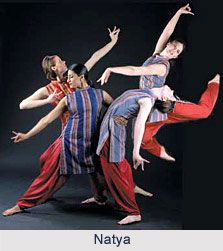 Traditional Indian theatre became an expression to reflect the unedited realities of life in the most expressive way. Although Indian theatre has its roots associated deeply with the verve of the ancient Vedic era ritualism yet it is in the medieval era with the introduction of the Traditional Indian Theatre, Indian drama further gained that maturity. For the very first time the varied Indian mythology and eposes of the Sanskrit theatre was rather rationalised. Gradually this established facet of Indian traditional theatre gained a coloured contour amidst the local and Indian folk theatre.
Elements of Traditional Indian Theatre
In traditional theatre ancient customs, age-old traditions and classical improvisations are ideally mingled to offer a rather contemporary tinge to Indian drama. The thematic development of Indian "natya" amidst the artistic techniques of Swang, Raslila, Indian drama, Jatra, Ankia Nat, Tamasha are therefore clearly reflected in the growth and development of the traditional Indian theatre. Song happens to be an important element in Indian society hence gradually it became the most dominant theme of the traditional Indian theatre form. Bit by bit monologue, dialogue, song, timber, music and dance all became an integral part of various types of traditional Indian theatre form. Traditional music became the means of expression and creativity therefore carved out a niche in the traditional Indian "natya" which has its roots deeply associated with ancient Indian culture, traditions and conventional Indian lifestyle. With the classical art form it is the very harmonious blend of sorrow, joy, love and all the realisms of life that later made the traditional Indian theatre a typical art form to stand apart amidst crowd.
Forms of Traditional Indian Theatre
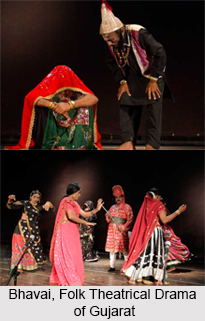
Traditional theatre forms integrate not only the common man`s interests but there is also a classical element in them. In traditional theatre forms there are unique styles of dance representing the entry on to the stage or platform, narrative and descriptive roles. The best example of descriptive acting is the Bidapat naach. In this traditional theatre form, importance lies not only on beauty but on acting and narrative and descriptive skills. Dance as a narrative art is the foundation of theatre form which can be seen in the traditional theatre form of Bhavai of Gujarat. In this form, swift or slow foot movement is a means of narration. The art of making the entry by dancing has been perfected in the traditional Kashmiri theatre form, Bhand Jashn. In Koodiyaattam and Ankia Nat, the entry by dancing itself is complicated and inventive. In the forms, the rhythm and basic pose and gesture identifies the role of the character.
In traditional Indian theatre, age-old forms, customs and the aspiration to improvise are intermingled. It is usually when the important themes are enacted, that the acting restricts itself to traditional norms, not deviating from it. But, every time the theme inches towards the contemporary, the actors improvise as far as dialogue delivery is concerned. In traditional theatre forms there is no formal setup leading the entry or exit of the actors. Depending on the circumstances or context, the actors enter into the stage and enact their role without being officially introduced. In traditional theatre forms, there is always stability in its theme, composition and presentation. There is also a scope for improvisation and incorporation of new references leading to subtle extension in the story-line. There is direct and warm communication between the actors and the audience.
Influence of Traditional Indian Theatre
Traditional theatre forms have undeniably been influenced by industrial civilisation, industrialisation, and urbanisation. The development of traditional theatre forms is based on such local and regional peculiarities which are not bound and restricted by social and economic divisions, limitations, etc. In traditional theatre forms, characters keep altering their place on the stage to be more inspiring and to give the situation a greater implication. This technique also reduces the chance of monotony through repetition and stillness. Dialogues delivery is usually carried out in a high pitch which helps the actors to reach out to a larger audience.
Ancient Indian Theatre Stages
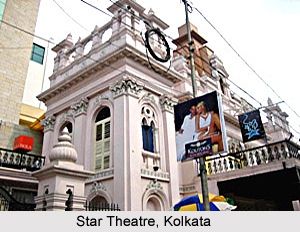 The Natyashastra by Bharata Muni depicts the mature form of a classical theatre of ancient India. Natyashastra is the most detail and elaborate of all treatises on dramatic criticism and acting ever written in any language. Bharata Muni here have discussed about a variety of topics in relation to the stage. The topics discussed in this work are: Mythical origin of theatre, its coming down to earth; construction of a play house, a stage, a tiring room and auditorium etc., ceremonies relating to the construction, preliminaries to a dramatic performance (ceremonies including songs, chants dances and instrumental music), choreographic elements (dance, gestures and movements of different parts of the body) and body in some conventional postures, costumes and make-up, classification of plays analysis of their structure, poetic aspects of plays and figures of speech in them, theory of music, metres of songs, chants, elocution, modes of playing instruments (Veena, flutes and drums) and Talas (time measure) to be observed during songs and playing of instruments, Roles and characters in plays (their classification, description and training of actors and actresses, members of theatrical troupes, and qualification of an ideal stage manager), criticism of a dramatic performance. Bharata Muni thus laid the foundation of the classical Theatre by composing the Natysastra.
Types of Playhouse
In Natysastra Bharata has discussed about three types of playhouse, oblong, square and triangular. These three have been further divided into large, medium and small. These measurements could be in terms of dandas or cubits, naturally giving us eighteen different dimensions of playhouse.
According to Natyasastra a regular theatre consists of three parts, the tiring room, the stage and the auditorium. The stage is required to have two Mattavaranis on the two sides. There was existence of permanent and temporary theatres in ancient India.
The stationary or permanent theatres were made of brick and wood. They had galleries for the spectators to sit. Plays were regularly enacted here in these permanent theatres. On the other hand moving or temporary theatres
The moving theatres were temporary theatres, which were built for short period to be dismantled afterwards. There were troupes of actors who moved from place to place and performed played before patrons.
Natyagrha, natya mandapa, preksagrha or preksagara are some of the Sanskrit terms that are utilised for the theatre. The Natyashastra have set down many rules for the construction of a theatre These theatres were constructed with bricks and wood that depicts its permanent character The palaces of kings in ancient India also had theatres and music halls attached to them. Females of elite family were imparted with knowledge of histrionics, music and dancing. The Silparatna, the Kavyamimamsa and the Sangita makaranda contain details about palace theatres. The Sangitaratnakara, however, highlights on the sitting arrangement in these theatres. These theatres were usually occupied by the kings, queens, courtiers, high civil and military officers, court-poets and the elite of the capital. They took the central place in the line flanked by the chief queen on the right side and other court-ladies on the left. The front row was also occupied by the ministers and military officers. Elite of the capital, gentlemen and ladies, occupied their seats behind the court ladies. The rest,that included the members of the royal family occupied the back seats. The Bodyguards stood in all the four-corners. Beautiful women guards holding chowries stood behind the king.
Natamandiras also had a prominent place in the ancientIndia Temple Architecture. In these natamandiras paid dancers or devadasis danced before the deity. Drama that were staged were in the praise of the deity. An example of such a dance is the Vttararamacharita enacted at the annual yatra in the honour of Kalapriyanatha.
On important festivals the nobility assembled to participate in the worship of the deity and also to witness the dances or the dramatic performances. Those were also the source of entertainment for them. However, the lowest order of the Hindu society was refrained from these temple performances. Stages temporarily built or in open court-yards plays were presented to the general public. The plays meant for the mass had singing, dancing and comic element in them. Subjects from the Mahabharata, the Ramayana and the Indian Puranas were represented on such stage.
Types of Traditional Theatres in India
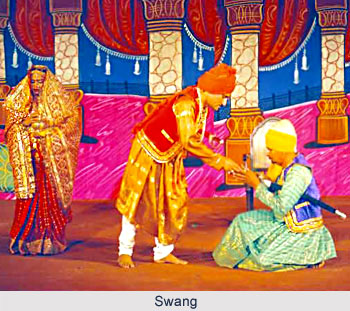 Types of traditional Indian theatres in India are varied with each Indian state having a distinct traditional theatrical form by itself. Bhand Pather, the traditional theatre form of Kashmir, is a distinctive combination of dance, music and acting. In this theatre form, music is provided with musical instruments such as surnai, nagaara and dhol. Satire, wit and parody are introduced here for inducing laughter. Since the actors of Bhand Pather are primarily from the farming community, the impact of their way of living, ideals and compassion is noticeable. Originally the theatre form Swang, was mainly music-based but gradually, prose played an important role in the dialogues. The softness of emotions, accomplishment of rasa along with the expansion of character is seen in this theatre form. The two important styles of Swang are from Rohtak and Hathras. In the style belonging to Rohtak, the language used is Haryanvi (Bangru) and in Hathras, the language is Braj Bhasha.
Traditional Theatre of North India
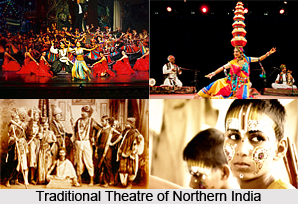 Traditional Theatre of North India lays bare the theatrical scenario of the state. The traditional theatre form, Nautanki, is generally associated with Uttar Pradesh. The most well known centres of this traditional theatre form are Kanpur, Lucknow and Hathras. The meters incorporated in the verses are Doha, Chhappai, Chaubola and Behar-e-tabeel. Previously only men acted in Nautanki but nowadays, even women have started taking part in the performances. Gulab Bai of Kanpur is one among those who is remembered with reverence. She gave a new dimension to this old theatre form. The theatrical form Raslila is based exclusively on Lord Krishna legends. In this theatre form the dialogues in prose are combined brilliantly with songs and scenes from Krishna`s life. Bhavai is the traditional theatre form of Gujarat. The chief centres of this form are Kutch and Kathiawar. The musical instruments used in Bhavai are bhungal, pakhaawaj, rabaab, tabla, bansuri, sarangi, manjeera, etc. In Bhavai, there is an unusual fusion of devotional and romantic sentiments.
Religious folk theatre of north India mainly comprised of Ramlila and Raslila narratives. The Nautanki groups of Uttar Pradesh and some of the other groups composed of English speaking Indians and foreigners, tried their best to continue the exclusive practices of the former rulers, providing entertainment both on and off the stage for whoever felt he belonged; their productions were social events more than anything else. The average Indian, whoever he may be, was left out.
Only with the emergence and the vision and energy of directors like Habib Tanvir and Ebrahim Alkazi, and the foundation, of the National School of Drama, in 1959 (whose director Alkazi became in 1962), did a process of experimentation and professionalization start which has since changed the Indian theatrical scene altogether and is still going on. In this process, directors, actors and stage technicians as well as their audiences tried, among other things, to make themselves familiar with non-Indian theatrical traditions and practices.
Some of the most important Indian plays written and produced in the late 1960s and early 1970s were influence by, if not modelled after, Western illusionist drama. Again, it was for directors like Alkazi and Tanvir to show a way, if not the way out of this dilemma: it led out into the Indian countryside. While the urban theatre seemed to be passing through a phase of stagnation, its rural counterpart (until recently looked down upon by most of the city dwellers) was going strong as usual, as would appear natural in a country about four fifths of whose population live outside the cities.
Traditional Theatre of Uttar Pradesh
The traditional theatre form, Nautanki, is generally associated with Uttar Pradesh. The most well known centres of this traditional theatre form are Kanpur, Lucknow and Hathras. The meters incorporated in the verses are Doha, Chhappai, Chaubola and Behar-e-tabeel. Previously only men acted in Nautanki but nowadays, even women have started taking part in the performances. Gulab Bai of Kanpur is one among those who is remembered with reverence. She gave a new dimension to this old theatre form. The theatrical form Raslila is based exclusively on Lord Krishna legends. In this theatre form the dialogues in prose are combined brilliantly with songs and scenes from Krishna`s life. Bhavai is the traditional theatre form of Gujarat. The chief centres of this form are Kutch and Kathiawar. The musical instruments used in Bhavai are bhungal, pakhaawaj, rabaab, tabla, bansuri, sarangi, manjeera, etc. In Bhavai, there is an unusual fusion of devotional and romantic sentiments.
Traditional Theatre of South India
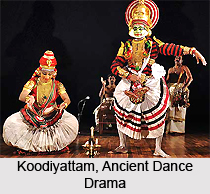
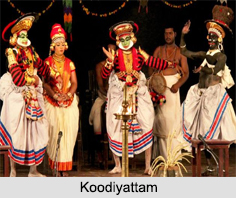
Traditional Theatre of South India consists of Ancient Sangam Literature particularly the epical works of Shilappadhikaram. They give clues to the rich theatre culture of South India. When Sanskrit Theatre began to decline in the Northern India it travelled to the South and there from the 8th Century until the present. Koodiyattam is the local style of staging Sanskrit plays that has been flourishing in the temples theatres of Kerela since 10th century. The classical dramatic traditions remained confined to theatres called Koothambalams while the folk traditions manifested in ritualistic and non-ritualistic theatrical forms such as Teyyam Kali Dance dramas and Bhuta dances.
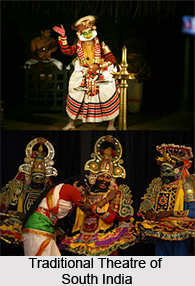 The traditional folk theatre form of Kerala is known as Mudiyettu. It is celebrated in the month of Vrischikam (November-December). It is usually performed only in the temples of Goddess Kali and depicts the triumph of Goddess Bhadrakali over the asura Darika. The seven characters in Mudiyettu-Shiva, Narada, Darika, Danavendra, Bhadrakali, Kooli and Koimbidar (Nandikeshvara) are all heavily made-up. Theyyam is a traditional and extremely popular folk theatre form of Kerala. Theyyam is performed by various castes to appease and worship these spirits. One of the distinctive features of Theyyam is the colourful costume and awe-inspiring headgears (mudi) nearly five to six feet high made of bamboos and wooden planks and dyed into different strong colours using turmeric, wax and arac.
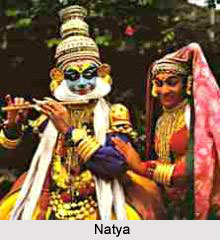
One of the oldest traditional theatre forms of Kerala is Koodiyaattam which is based on Sanskrit theatre traditions. The characters of this theatre form are Chakyaar or actor, Naambiyaar, the instrumentalists and Naangyaar, those who portray the women`s roles. The Sutradhar or narrator and the Vidushak or jesters are the protagonists. It is the Vidushak alone who delivers the dialogues. Importance on hand gestures and eye movements makes this dance and theatre form unique. Yakshagaana, the traditional theatre form of Karnataka, is based on mythological stories and Indian Puranas. The most popular episodes are from the Mahabharata i.e. swayamvar of Draupadi, Subhadra vivah, Abhimanyu vadh, Karna-Arjun yudh and from Ramayana i.e. Rajyaabhishek, Lava-kusha Yudh and Panchavati.
;
Traditional Theatre of Tamil Nadu
In Tamil Nadu, Therukoothu is the most popular form of folk drama. It is generally performed at the time of annual temple festivals of Mariamman (Rain Goddess) to achieve prosperous harvest. In Therukoothu there is a cycle of eight plays based on the life of Draupadi. Kattiakaran, the Sutradhara of the Therukoothu performance, gives the gist of the play to the audience and Komali entertains the audience with his buffoonery. The traditional theatre forms of Swang, Nautanki, Bhagat, etc. are usually similar. There is often stylistic variety, which toughens their distinctiveness. Therukoothu is a traditional street play of Tamil Nadu. The art of entertainment had reached to its peak in Tamil Nadu at an early age. There were mainly three forms of entertainment in ancient Tamil Nadu. These include the `iyal` (literature), `isai` (music) and `natagam` (drama). All these had their roots in the rural folk theatre like `therukoothu`, an energetic living theatre of Tamil Nadu. According to the traditional system, only the male members can be seen in a Therukoothu troupe. It is organised mainly during the summer months when there is little agricultural work. The performers wear complex and heavy costumes and make up. They put on high towering head dress, sparkling shoulder plates and wide colourful skirts. They put on elaborate make up which helps to transfer the audience into the world of the mythological characters. The orchestra of `Therukoothu` consists of a `mukhaveena`, an `mridhangam`, a harmonium and cymbals played by the natuvanar.
The art form `Therukoothu` is more popular in the northern districts of Tamil Nadu. This street play is generally organised in the villages of Tamil Nadu during the festivals in the months of `Panguni` i e, in March-April and Aadi i, e, July-August. The Therukoothu play generally commences in the late evening and concludes only during the late hours of the nights. The performers of this art form keep the audiences stick to its end and nobody leaves the play in the mid-way. Actually, the performance is so attractive that no one can think of leaving half way. The usual timing of Therukoothu performance is from 9 pm till sunrise. Bhagavati Pattu, Tolpava Koothu, Pavakathakali are some of the famous South Indian Theatre.
Traditional Theatre of Eastern India
Traditional Theatre of Eastern India is the cultural junction point of the eastern India. Amongst the states of eastern India is Assam, Bengal, Bihar etc. Indian drama has an unbroken history of over two thousand years. Round about contemporaneous with Aristotle`s poetics, antique India created a genre of its own by the dint of an encyclopaedic manual on theatre called Natyashastra ascribed to Bharata, which became the basis Indian performances genres for centuries to come. This means that there already a rich tradition of performance practice long before such a work appeared. The aesthetic theory of rasa briefly but cogently expounded in NS influenced Indian aesthetic theory and practice for more than a millennium. The first millennium was also pigeonholed by the great harvest of Sanskrit drama by pre-eminent play-wrights like Bhasa, Kalidasa, Shudraka, Vishakadatta, Bhavabhuti and Harsha.
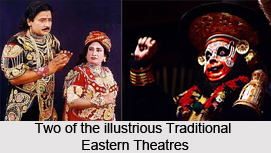 Traditional Theatre of Assam
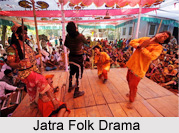
Bhaona is a staging of the Ankia Nat of the state of Assam. In Bhaona cultural glimpses of Assam, Bengal, Orissa, Mathura and Vrindavan are reflected. The Sutradhar, or narrator begins the story, first in Sanskrit and then in either Brajaboli or Assamese. Jatra is a famous folk theatre from Bengali theatre that is spread throughout most of Bengali speaking states of India including West Bengal, Bihar, Assam, Orissa and Tripura. Lots of people, actors and actresses are involved in this form of art in West Bengal and other parts of India. Jatra is considered as a famous form of traditional folk theatre from the eastern region of India. It literally means a journey and hence, stylized delivery and exaggerated gestures and orations are some of features of Jatra.
Jatra is believed to have originated from ceremonial functions that are called before starting on a journey. There are also the other legends saying, that it developed from processions brought out in respect of different gods and goddesses. These processions often included songs and dances as its primary part. Jatra is a form of Indian folk drama combining acting, songs and music and dance altogether by the troop that is travelling from one place to another. In the earlier years, the religious values were well communicated with the help of Jatra to the masses. Jatra performances in West Bengal resemble the Tamasha of Maharashtra, the Nautanki of Uttar Pradesh and Bhavai Dance of Gujarat. Even if the birthplace of Jatra lies in religious landscapes, filled with different Bhakti cults of Hinduism, but it is replaced by morally educative contents by the end of 19th century. As a result, during Bengal Renaissance, it gained entry into the urban theatres. Various parts of Hindu epics like Mahabharata and Ramayana was also preformed. Later on, the Jatras were held beside palas, and sometimes even replacing it.
Traditional Theatre of West Bengal
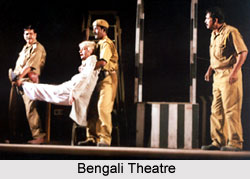
Fairs in honour of gods, or religious rituals and ceremonies within their framework of musical plays are known as Jatra. This form was born and nurtured in Bengal. Krishna Jatra became popular due to Chaitanya`s influence. Later, however, worldly love stories too, established a place in Jatra. Earlier Jatra was primarily musical. Dialogues were added at a much later stage. The actors themselves described the change of scene, the place of action, etc. Jatra is believed to have originated from ceremonial functions that are called before starting on a journey. There are also the other legends saying, that it developed from processions brought out in respect of different Gods and Goddesses. These processions often included songs and dances as its primary part. Jatra is a form of Indian folk drama combining acting, songs and music and dance altogether by the troop that is travelling from one place to another. In the earlier years, the religious values were well communicated with the help of Jatra to the masses. Jatra performances in West Bengal resemble the Tamasha of Maharashtra, the Nautanki of Uttar Pradesh and Bhavai Dance of Gujarat. Even if the birthplace of Jatra lies in religious landscapes, filled with different Bhakti cults of Hinduism, but it is replaced by morally educative contents by the end of 19th century. As a result, during Bengal Renaissance, it gained entry into the urban theatres.
Traditional Theatre in Western India
Traditional Theatre in Western India is an integral part of Traditional Indian theatre became an expression to reflect the unedited realities of life in the most expressive way. Although Indian theatre has its roots associated deeply with the verve of the ancient Vedic era ritualism yet it is in the medieval era with the introduction of the Traditional Indian Theatre, Indian drama further gained that maturity. For the very first time the varied Indian mythology and eposes of the Sanskrit theatre was rather rationalised. Gradually this established facet of Indian traditional theatre gained a coloured contour amidst the local and Indian folk theatre.
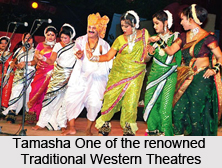 Traditional Theatre of Maharashtra
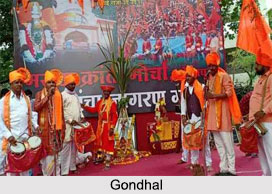
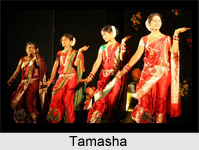
Tamasha is a traditional folk theatre form of Maharashtra. It has evolved from the folk forms such as Gondhal, Jagran and Kirtan. In Tamasha the female actress is the chief exponent of dance movements in the play which is unlike the other theatrical forms. Classical music and vivid gestures make it possible to depict all the emotions through dance. Tamasha is a form of theatre, which came into existence in the early 16th century in Maharashtra, which includes the love songs i.e. `Lavanis` due to which, this folk art, was very popular among the common people. Not only during its inception, but even today Tamasha happen to be one of the most awaited folk performances in the Indian state of Maharashtra. Tamasha includes songs and dance along with the musical instruments like the Dholki drum, `Tuntuni` (a single string instrument), `Manjira` cymbals, `Daf` (a tambourine-like instrument with a single leather surface), `Halgi` (smaller Daf), the metal triangle called `Kade`, the `Lejim` (an instrument with a jangling sound), the Harmonium and `Ghunghroos` (ankle bells). Tamasha is associated and performed with two of the communities of Maharashtra, viz: Kolhati and Mahar.
Tamasha can be performed, anywhere, without the construction of any special stage like the village square, the courtyard of any house, an open ground or even on an artificial stage. The overwhelming performance begins with the entry of the musicians as in the other dance-drama forms. At the beginning two percussionists named the dholkiwala and the Halgiwala enter in the scene. Here, while the dholkiwala provides the basic rhythm by playing the usual metrical cycles on the dholak, the Halgi provides the sharp accents and other piercing sounds, which add up as the musical background of Tamasha. The musical compositions of the Tamasha have a simultaneous use of the Raga and the incorporation of many folk and indigenous melodies. Amongst the Hindustani Ragas used for Tamasha Yaman, Bhairavi, and Pilu are common.
Traditional Theatre of Goa
Dashavatar is the most developed theatre form of the Konkan and Goa regions. The performers embody the ten incarnations of Lord Vishnu, the God of preservation and creativity. The ten incarnations of Lord Vishnu are Matsya (fish), Kurma (tortoise), Varaha (boar), Narsimha (lion-man), Vaman (dwarf), Parashuram, Lord Rama, Lord Krishna (or Balarama), Lord Budha and Kalki. Apart from stylised make-up, the Dashavatar performers wear masks of wood and papier mache. Krishnattam, folk theatre of Kerala, came into existence in the middle of 17th century A.D. under the patronage of King Manavada of Kolikod. This theatrical form is a cycle of eight plays performed for eight consecutive days. The plays are Avataram, Swayamvaram, Kaliamandana, Rasa krida, kamasavadha, Bana Yudham, Vivida Vadham, and Swargarohana. The episodes are based on the theme of Lord Krishna, his birth, childhood and different deeds illustrating the victory of good over evil.
Konkani "tiatr" is one of the traditional forms of Indian theatre for its high entertainment value, and is unique to Goa. On the regular stages it is performed as a Konkani play that even includes songs which are inherent to the play. A tiatr generally lasts for hours and usually has songs and 7 acts of barely 15 minutes extent each having elaborated sets and professional lighting effects. The songs generally sung in between in actuality were meant to fill the gap between the acts. However as time passed and modernization slowly crept in, they are generally supported by a Western-style band today and many people go to see the songs rather than the main play. Independent of the main theme, they are based on controversial, current and local issues which are popular amidst the common mass and providing food for thought owing to the contemporaeneity of the themes.
This particular theme was introduced by Lucasinho Ribeiro from the Assagao village in Bardez who went to Mumbai when he had been in a job with the Italian Opera Company. He soon left the job and by translating an Italian Opera word by word he created `Italian Burgo` the first ever Konkani tiatr. The rich Traditional drama forms such as "zagor" and "khell" were ubiquitous in Goa before tiatr was invented. These musical plays with an all male cast that were performed in an open ground in villages provided rural entertainment to the rustic folks. There are two forms of Zagor performed by the Hindu Perani community and the Christian Gawda community. The one performed by the Hindu community is called Perani Jagar. Right from the 1950s, Khell now known as "Khel Tiatr" or "non - stop" in English has seen a revival when performed on an open ground on stage.
Traditional Theatre of Central India
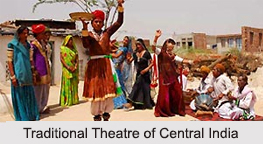 Traditional Theatre of Central India has encompassed all the other forms of literature and fine arts into its physical presentation: literature, mime, music, dance, movement, painting, sculpture and architecture. The popular and the only traditional theatre form of Central India is the "Manch".
"Manch" is the theatre form of central India, especially of Malwa region of Madhya Pradesh. The term "Manch" is used for the stage itself as also for the play. In this theatre form songs are given prominence in between the dialogues. The term for dialogue in this form is "Bol" and rhyme in narration is termed "Vanag". The tunes of this theatre form are known as "Rangat".
Presently, "Manch" is a flourishing theatre form of central India. There are a large number of troupes spread all over Malwa region and more than one hundred plays have been written in Malwa dialects which are staged regularly.