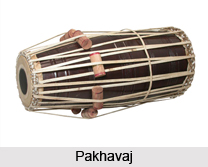
 Pakhavaj is a percussion instrument used mostly in North Indian Classical Music. It is quite similar to the south Indian Mridanga, and is even sometimes referred to as Mridang in the North. The name "Pakhavaj" may have been derived from the Dvaf, a drum used in Mughal courts. In the memoirs of the emperor Akbar, the Avaj is described as "two kettle drums joined together at the reverse ends, their heads covered with skins and braced with thongs." The Pakhavaj was the predominant drum in Mughal times: it was used to accompany vocal music, such instruments as the Bin and Rebab, and dancing.
Structure of Pakhavaj
The Pakhavaj is a modified barrel-shaped drum that is constructed in various sizes. The dimensions of the drum fluctuate from approximately 66 to 76 cms in length and from 20 to 30 cms in diameter at its greatest girth. An asymmetrically placed point is between 2 and 5 cm closer to the bayah (left) end than the dahina (right). The presence of this point places the Pakhavaj somewhere between a double cone and a barrel. The design of the heads on the Pakhavaj is slightly different. The outer layer of skin is cut away more than on the Mridanga. This leaves more of the surface of the second layer exposed and makes the playing area wider. This difference apparently lowers the degree to which the higher partials are damped on the Pakhavaj, and its pitch is, therefore, not as clear as that of the Mridanga. The dahina (right) head is from 16 to 19 centimetres in diameter, the bayah (left) head from 25 to 28 centimetres. A wheat-flour paste (ata) is placed on the Pakhavaj bayari head prior to each performance. The quality of the leather on the heads of the Pakhavaj and Mridanga is also different, as is the tensions on their surfaces. The cylindrical blocks of wood between the leather braces and the body of the Pakhavaj are bigger than those on the Carnatic instrument. Some of the playing techniques differ as well. Like the Mridangam, the Pakhavaj is kept horizontally on the ground or on the lap and played with the hands; in other words, it is an Ankya drum. Tuning is done just as in the Tabla: by means of tuning blocks (Gattha) as well as striking on the Gajra.
As this instrument was closely linked with the Dhrupad style of singing and the Bin, it is the relatively rare bin performances today which are still accompanied by the Pakhavaj, as are the more frequent occasions of dhrupad singing. Gopal Dass, Madhavrao Alkutkar, and Lakshmi Narayan Pawar have been among the few notable Pakhavaj players in recent times. Today there are not many virtuosi on this drum which is still restricted to accompany the Dhrupad, the Veena and Kathak dance. Efforts are, however, being made at various levels to revive it, because the Pakhavaj has a fine dignity and sobriety of tone and technique, not possible in the Tabla.