


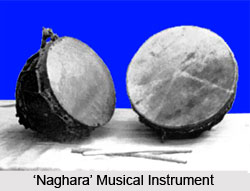
 Naghara is a percussion instrument popular in North India. It is a drum that was used in the naubat ensemble in Mughal courts to accompany the shehnai. It is still frequently used on the concert stage with the shehnai. Naghara is a percussion instrument popular in North India. It is a drum that was used in the naubat ensemble in Mughal courts to accompany the shehnai. It is still frequently used on the concert stage with the shehnai.
History of Naghara The term 'naqqara' was referred to the Iranian 'Kus' which is a musical instrument made of wood, clay or metal. This was after the conquest of Iran. The term "Naqqara" finds a mention in numerous literary works composed by several scholars and poets. Naghara's style and design is similar to the kus. The sound made by the drum used by this instrument is known as 'Dambel-e Dimbo'. The other names of Naghara include 'naqqare', 'kase', 'gavorga', 'khom' and others. In India, the term naqqara is pronounced as 'nagara' or 'nagada'. Nowadays, the Nagara is played in combination with the Indian 'oboe' or 'shenai', especially during marriages held in North India. Structure of the Naghara It is a single-headed conical drum, with a shell of riveted copper, brass, or sheet iron. The size of the naghara varies extremely, but often a concert instrument will have a diameter of two and a half to three feet. Two nagharas, one much smaller than that described above, are used to accompany shehnai players. The pair is played by one drummer. The larger drum (dhama) is made of metal, and its height and diameter are of equal proportions. The smaller drum (jhil) is made of clay or metal. Usually, it is shallower-from twenty-three to twenty-five centimeters high- and the diameter of its head is twenty-eight to thirty centimeters. Though the relative sophistication of the method for binding the head to the drum is less, this method is basically similar to that used on the 'tabla', 'pakhavaj', and 'dholak', a drum used in folk music. The binding laces are not drawn directly through the skin of the head, but in both cases are secured to other cords which form part of a band which encircles the upper rim of the drum. This method of binding ensures a more even distribution of tension and hoops to secure the head to the drum. The lacings form an X-type grid. Tuning of the Naghara Though neither drum lends itself readily to precise tuning, the tension of both heads may be altered. The dhama may be altered by the application of water, and the tension of the jhil cam be altered by the application of heat. The Dhama often has a glutinous tuning paste placed under the centre of its head. Playing the Naghara Traditionally, the instrument of the Naghara is played with the help of sticks called 'damka'. The instruments produce a sharp, resonant sound that can carry quite far. Often, this instrument is played in pairs, wherein one 'naqqara' is utilized for playing the beats with high pitch and another for producing low pitch beats known as 'nar'. |
| |||



Home > Movies & Entertainment > Indian Music > Indian Musical Instruments > Percussion Instruments > Naghara
Naghara
| Naghara is an instrument belonging to the percussion family. It is used quite often to accompany the shehnai. |
| ||||||||||||||||||||||||||||

