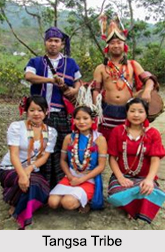
 Tangsa Tribe is one of the major tribes of Arunachal Pradesh who are mostly found in the hilly areas of Changlang district and in parts of Tinsukia district of Assam The word Tangsa means the "children of the hills". They are a scheduled tribal group under the Indian Constitution.
Origin of Tangsa Tribe
They are found in the extensions of Patkai range. It is assumed that they came to this region in search of agricultural land and decided to settle here. They had migrated to the regions of Arunachal Pradesh in the 13th century from the south-west provinces of China through Burma. Physically they belong to the Mongoloid racial stock.
Society of Tangsa Tribe
Tangsa Tribe includes several sub-tribes like Youngkuk, Tikhak, Lungchang, Muklom, Mosang, Morang, Lungphi, Lungri, Kimsing, Yogi, Rong Rang, Sanke, Snagwal, Havi and Tonglim. The first four groups are collectively known as Tangwa. Each group of Tangsa tribe speaks a separate dialect which belongs to the Tibeto-Burman language families.
Tangsa society is patrilineal. Generally, they have joint or extended family structure which is headed by the father. The daily affairs of the Tangsa tribe are taken care of by a Lungwang chief known as "Khaphua". Monogamy is the rule but in special case polygamy is also permitted. Cross-cousin marriages are very common.
 Administration of Tangsa Tribe
In the Tangsa society the most powerful political body in the village is the council of the elders. The entire machinery of village control revolves round this council. All cases arising in the village are brought before this council. Both the executive and the judicial powers are vested in this council. The council is headed by the village head man.
Occupation of Tangsa Tribe
The Tangsas are agriculturists. Through Jhum cultivation and wet they grow paddy. Their staple crops are ginger, chilli, turmeric and so on. Seasonal crops and fruits such as orange, lemon, cabbage and spinach are also cultivated.
Traditional Dress of Tangsa Tribe
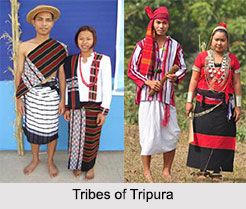
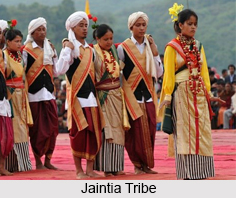
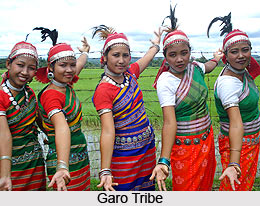
Their dress can be divided into two parts-one that is worn below the waist and the other over it. The males wear "Khatsam" or Lungi below the waist and "Samkhong" or Shirt. The women folk also use lungi to cover lower portion and "Samkhatop" or blouse for upper part of the body.
Art and Crafts of Tangsa Tribe
The Tangsa tribes are expert in textile designing, as well as in making bamboo and came products. They are good black smiths too. Their basketry and hand weaving are special attractions. Conical basket is the most important for them.
Religious Life of Tangsa Tribe
The Tangsa people generally follow the Donyi-Polo religion. The Supreme Being is locally known as "Rangfrah". Even Theravada Buddhism has had a major influence on the religious life of Tangsa people. As a result some of the religious rites of Theravada Buddhism have been imbibed into the lives of Tangsa people. In the recent years there have also been a few converts to Christianity.
Festivals of Tangsa Tribe
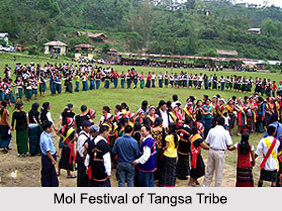
Mol is the main festival of the Tangsa tribe which is celebrated every year in the month of May-June. A village is nominated for holding the festival. The host village sends formal invitations to all other villages of the area and makes arrangements for every body"s food and staying. It is celebrated with traditional dances and a feast. Mol is a post harvest festival.