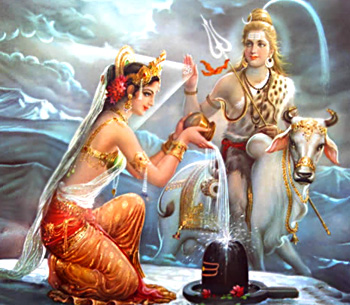
 Legend of Uma narrates the tale of the rebirth of Sati in the form of Uma. Sati was reborn as the daughter of the great mountain Himalaya, when her name was Uma, surnamed Haimavati from her birth and she got another name as Parvati, daughter of the mountain. Her elder sister was the River Ganga. From her childhood Uma was devoted to Shiva, and she would steal away at night to offer flowers and fruits and to burn lights before the lingam. A deva, too, one day predicted that she would become the wife of the Great God. This awakened the pride of her father, and he was anxious that she should be betrothed; but nothing could be done, since Shiva stayed immersed in profound contemplation, oblivious of all that went on, all his activity inward-turned.
Uma became the servant of Lord Shiva and attended to all his requirements, but could not divert him from the practice of austerities or awaken his love. At that time a terrible demon by the name of Taraka, created problems for the gods in the world and perverted all seasons and destroyed sacrifices. The gods could not defeat him, since in the past age he had won his power from Lord Brahma himself by the practice of austerities. The gods therefore proceed to Brahma and prayed for his help. He explained that it would not be fitting for him to proceed against the demon, to whom he himself had given power; but he promised that a son should be born to Shiva and Parvati, who would lead the gods to victory. After getting to know the way in which the rakshasa would be killed, the chief of the gods, Indra, went to Manmatha, (Kamadeva or Desire, the god of Love), and explained the need of his assistance. Desire agreed to give his aid, and set out with his wife Passion and his companion, the spring to the mountain where Shiva dwelt. At that season the trees were putting forth new flowers, the snow had gone, and birds and beasts were mating; only Shiva stayed in his dream unmoved.
Kamadeva Consumed by Shiva`s fire
Desire or Kamadeva even daunted till he took new courage at the sight of Uma`s loveliness. He chose a moment when Shiva began to relax his concentration and when Parvati approached to worship him. Then he drew his bow and was about to shoot when the Great God saw him and darted a flash of fire from his third eye, consuming Desire utterly. Shiva departed, leaving Passion unconscious, and Parvati was carried away by her father. From that time Ananga, Bodiless, has been one of the name of Kamadeva, for he was not dead, and while Passion lamented her lost lord a voice proclaimed to her that her lover was not lost for ever and when Shiva shall wed Uma he would restore the body of Love to his soul as a marriage gift to his bride.
Shiva Accepts Love of Parvati
Parvati then reproached her useless beauty, since her beauty were not enough to draw the attention of her beloved, Lord Shiva. She became a sanyasini, an anchorite, and laying aside all jewels, with uncombed hair and a hermit`s dress of bark, she retired to a lonely mountain and spent her life in meditation upon Shiva and practiced austerities which were dear to her lord. One day a Brahmin youth visited her, offering congratulations upon the constancy of her devotion and asked her for what reason she thus spent her life in self-denial since she had youth and beauty and all that heart could desire. She related her story, and told that since Desire was dead she saw no other way to win Shiva`s approval than this devotion. The youth attempted to dissuade Parvati from desiring Shiva, recounting the terrible stories of his inauspicious acts. He told her how he wore a poisonous snake and a bloody elephant-hide, how he dwelt in cremation grounds, how he rode on a bull and was poor and of unknown birth. Parvati was angered and defended her lord, finally declaring that her love could not be changed whatever was said of him, true or false. Then the young Brahman threw off his disguise and revealed himself as no other than Shiva, and he gave her his love.
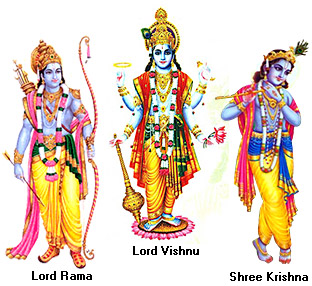
Parvati returned home to tell her father of her happy fortune, and the preliminaries of marriage were arranged in due form. At last the day came, both Shiva and his bride were ready and the former, accompanied by Lord Brahma and Lord Vishnu, entered Himalaya`s city in triumphal procession, riding through the streets ankle-deep in scattered flowers, and Shiva bore away the bride to Kailash and also restored the body of Desire to his lonely wife.
Shiva and Parvati dwelt in bliss in their Himalayan paradise for many years and at last the god of fire appeared as a messenger from the gods and reproached Shiva that he had not begotten a son to save the gods from their distress. Shiva bestowed the fruitful germ on Fire, who bore it away and finally gave it to Ganga River, who preserved it till the six Pleiades came to bathe in her waters at dawn. They laid it in a nest of reeds, where it became the godchild Kumara; the future god of war. There Shiva and Parvati found him again and took him to Kailas, where he spent his happy childhood. When he had become a strong youth the gods requested his aid, and Shiva sent him as their general to lead an army against Taraka. He conquered and slew the demon, and restored peace to Heaven and earth. Ganesha was the second son of Shiva and Parvati. Lord Ganesha is the god of wisdom and the remover of obstacles.