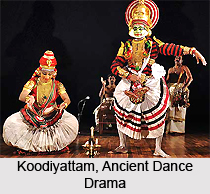
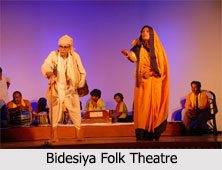
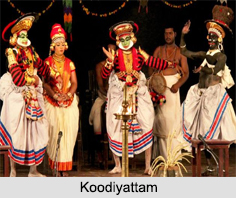
 Development of theatre in India improvised on the fine arts such as music, dancing, painting and above all dramatic art. The theatre should have state patronage and should be developed on national lines based on the technique observed on the ancient Indian stage but adapted according to the needs of the current times. The modern Indian stage can certainly be remodelled on the lines of the stage in ancient India to suit the native intellect of the country.
The development of the stage during the last century incorporating features from the provincial theatres, from the primitive Tamil theatre to the most artistic one of Bengal reveals a great diversity of culture. But a fundamental unity is found in the midst of this great diversity. Mythological heroes have commanded reverence throughout the country. Love of the emotional, the imaginative and the idealistic rather than of the intellectual and the purely realistic is a national trend. Sanskrit plays are performed now mostly in universities, colleges and in the temples of the South. Sanskrit plays are also staged today but not regularly. In recent years, outstanding attempts have been made to revive an interest in Sanskrit dramas to meet educational objectives. In theatre structures in South, portions of Sanskrit plays are still performed.
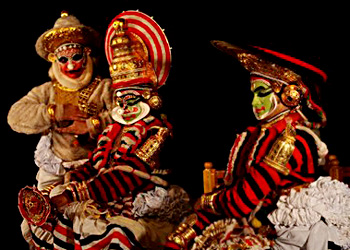
Plays like Malavikagnimitra, Urubhanga have been staged by eminent dramatists recently. These productions which contain elements, conventions, techniques and devices relating to more than one traditional theatre, are bound to serve as landmarks on the contemporary theatre. The folk theatre of India has flourished along with the classical theatre. Folk art forms and stage performances, which are equally important as classical ones are spontaneous not following a fixed course or a very rigid conventional mode and were performed for the masses mostly in temples and village squares. Through the folk theatre, the thread of our cultural heritage and the identity of the Indian art have been preserved as they symbolise the habits, traditions and the culture prevalent in the villages. Even in the field of aesthetics a special stress is laid on the study of folk art as a significant element of society.
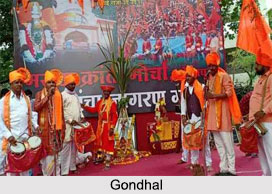
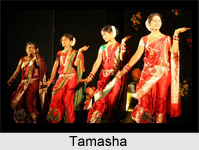
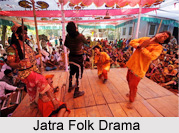
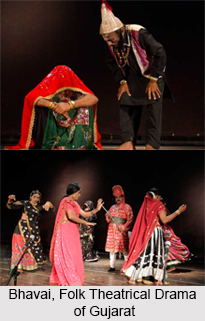
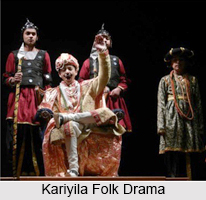
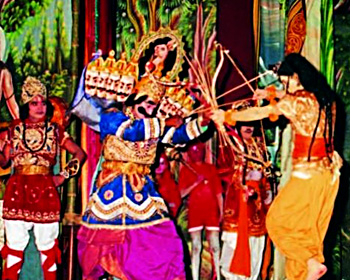 The details of staging of Indian folk theatre, a popular form of entertainment and employment of costumes, make-up, rituals, brilliant spectacle, and its performances are interesting. The cycles of plays such as Ramlila based on the Ramayana are performed in Ramnagar, Varanasi and elsewhere. Certain characteristics are common to the folk drama; the use of outdoor settings and arena stages, the telescoping of time and space by a commentator singer, the incorporation of music and dance with dramatic action, the prominence on stylisation and importance of colour; the role of the clown who reveals life through ridicule and humour and the direct participation of the audience with the performance. The folk play is performed in a variety of arena settings: round, parabolical, horizontal, and square and multiple set stages with special types of gangways and `flower paths`. The folk actor uses very few props. He creates palaces, rivers, forests, battle scenes and royal courts by the sorcery of his art.
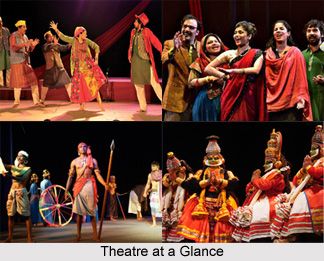
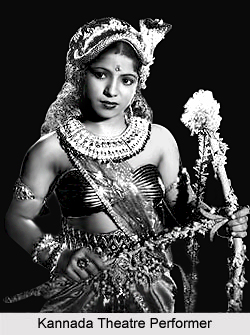
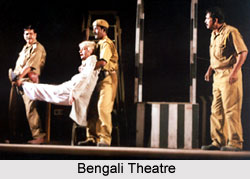
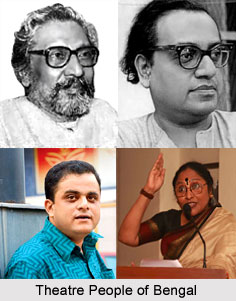
The modern Indian stage in its process of evolution has absorbed the cultural richness of the classical drama, the folk traditions of the medieval times and above all the influence of the West. The Madras theatre in fact includes the Tamil, Telugu and Kanarese theatres. The Tamil theatre still indulges in medieval practices; plaintive songs and acrobatic feats to arouse interest. The Telugu stage is, on the other hand is developing more speedily, while going through the mythological, bookish, historical and social types of productions. The Kanarese theatre is making remarkable progress in Bengaluru and some noteworthy companies are coming into existence in Mysore. Bengal has a regional theatre which has gone far ahead in realising the ideal of a true synthesis of old and new forms, without of course, actually reviving the old folk theatre. The Bengali stage is highly artistic. Its distinguishing feature is that all feminine roles are played by women. The novel use of song and dance is another special feature of the theater in Kolkata.
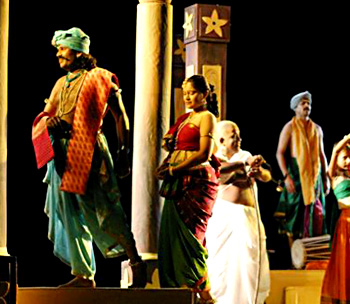 Like the Bengali theatre, the Marathi theatre began mainly under British influence, but soon liberated itself from it and established a considerable repertoire which is good as literature as well as for purposes of the theatre. Scenes and costumes in Marathi drama and theatre lack splendour. It concentrates its effort on natural acting and scientific music. It follows the system of discontinuous serious scenes with light ones. The Hindi theatre, comparatively a later development, has been developing in Uttar Pradesh after the appearance of the dramatist, Bharatendu Harish Chandra. By far the greatest contribution to the Hindi stage has surely been made in recent years by the actor producer, Prithviraj Kapoor, who started his Prithvi Theatre in 1945 in Mumbai. Prithviraj did a genuine service to the country by bringing life and vigour to the Hindi stage. The theatrical performances of Prithviraj were very simple, natural and well-timed, and had a great appeal to the minds of the cultured.
There is no lack of motivation in the bits and pieces of the broken tradition of our theatre. Though India cannot gain much by reviving the formalism of the ancient theatre, it is likely that it will gain a lot by questioning into its old craft of comedy, tragedy, farce and the morality plays. A regular return to folk feeling, which is rooted in the real life of the people, can bring an authentic sense of reality to the Indian stage today. The Rasa, the Nautanki, the Ramlila, the Krishna Lila, the enactment of the victory of the Pandavas over the Kauravas, the Muharram, the Holi as well as the several harvest dance dramas are the apotheosis of the old drama survivals which are an important reservoir of energy, from which a new living art of the theatre can be enhanced.
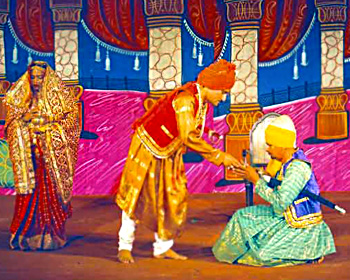 It may be suggested in the present content that together with with the creation of new plays, effort should be made to stage the plays of Bhasa, Kalidasa, Bhavabhuti, Rabindranath Tagore, Prasada etc., in the diverse provincial languages and Hindi. The arrangement should be made for translation, abridgment and the modification of their language. Really talented and educated people, who can understand and appreciate dramatic art and who have true love for self-sacrifice, should be asked to make arrangements for the founding of a national theatre in India. A fundamental unity must be maintained in the direction of the stagecraft followed in different theatres. This can be-done by relying on the ideals and culture of the country as a whole. The orthodox Indian notions of propriety and etiquette must be maintained. Though modern means of representing objects can be used, the ancient Indian methods should not be entirely overlooked. The use of curtains and wings should be highly developed. Music, dancing and histrionics for the modern stage should be employed on the models of ancient India.
Theatres in modern India must be a place, where solely Indian dramas whose object is to produce rasa in the minds of the spectators are performed, where a well developed colour scheme is employed, where the hair, dress and other equipment follow the pattern of Indian life, where classical music, dance and histrionics are encouraged, in short, where the ideals of Indian society are maintained. To achieve the above ideal the Government of India should encourage dramatists, dancers and musicians of worth and reputation. They should also help in the institution of a truly Indian theatre where all kinds of plays, whether in Sanskrit or any modern Indian language, may be performed according to the requirements of the day. A happy combination of ancient techniques and modern requirements will surely offer a very strong foundation to the National Theatre.