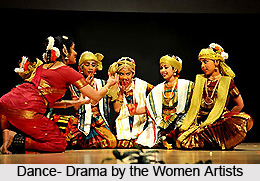
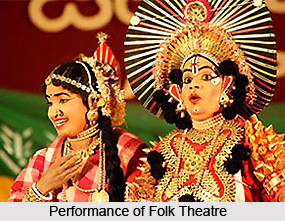
Angikabhinaya in Indian theatre includes the gesture and the movement of limbs. "Anga", "pratyanga" and "upanga" are the three ways to express Angikabhinaya. The head, hands, chest, sides, waist and feet are called "angas". The neck is also considered as an "anga". The shoulder-blades, arms, back, abdomen, thigh and shanks are called "pratyangas". Elbows, knees and the neck are also added to the list of "pratyangas". The shoulders, eyes, eye-brows, cheeks, nose, jaws, lips, teeth, tongue, chin and face are called "pratyangas". Then there are the heels, ankles, toes and fingers. When an "Anga" (major limb) moves, then the "pratyanga"and "upanga" also move.
Classification of Angikabhinaya
Angikaabhinaya can also be classified as:
•Shaka: It has the hand movements, hand gestures, and mudras.
•Ankura: Movements of the eyes, neck, face and head.
•Nrtta: It has just the body movement.
Nrtta means the body movements, while "natya" is the drama part, so "nrtya" would be a drama presented throughout the medium of movement, dance and mime.
Significance of Angikabhinaya
In Angikabhinaya, the different parts of the body are described and motions and gestures and their significance are assigned. The head is described as "akampita" when it is moved slowly up and down, and when this movement is done quickly it`s termed as "kampita". There is a distinct significance for each movement. The glance changes according to the emotion and the pupils move in different ways to express diverse sentiments and situations. Mudras or gestures by fingers are the most powerful means of expression in a dance. In the Natyashastra, gestures by fingers are said to include the divine action of celestial dancers and their application to the feelings and aspirations of human beings. Gestures of the hand signify different objects. For example, when the four fingers are outstretched parallel to one another and the thumb is bent, the flag hand is formed. When the hand is held against the forehead it is done to express blows, injuries, oppressions, delight or arrogance. The same posture of the hand with the fingers separated from one another indicates the glare of heat, torrential rain or flowers.
Presentation of Angikabhinaya
The movements of chest, flanks, abdomen, hips, thighs, feet and legs are also important part of Angikabhinaya. Natyashastra deals intricately with different caris, mandalas and gatis. Cari is an attempt to set aright the feet, thighs, chest and abdomen. It is employed in dancing, movements, dropping of weapons and in battle. Thus natya is dependent on cari. In natya, there is no movement of limbs without cari. The Natyashastra states that there are 32 caris and they are divided into two classes: earthly (bhauma) and heavenly (akasagami). According to the Natyashastra, there are 20 mandalas which are divided into earthly (bhauma) and heavenly (akasika). But the Abhinayadarpana on the other hand states that there are only 8 caris and 10 mandalas.
Angikabhinaya deals with the methods of unfolding through bodily gestures natural phenomena such as dawn, night, twilight, day, the six seasons and the sky, mountains, oceans, stars, moonlight, heat, wind and the mid day and evening sun, lightning; human beings and animals. The objects stationed in heaven such as gods, expressions of contentment, anger, envy, calamity, melancholy, fear, intoxication, bravery and a variety of emotions. Darkness is portrayed by people by slipping and grounding their way with their hands. Expression of joy is shown by one embracing the other`s body as well as by smiling eyes. Each and every part of the body is essential to signify some emotion or mood. Deep significance lays in the manner, in which the head is shaken, the eyes and brows are moved; the cheeks, nose, lips, chin and neck can all be used to suggest subtle themes.
In Indian theatre, there are many themes which are indicated by means of tokens and gestures. The art of angikabhinaya was fully developed and an object, which was not procurable, must have been represented by means of bodily gestures.