


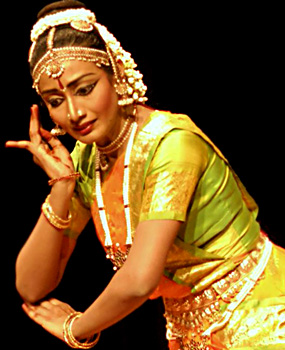
 Alankara is the second kind of aharyabhinaya, that is the arrangement of costumes and make up of the performers on the stage. There are three kinds of alankara or decoration. Ornaments made of corals, diamond, silver and gold, garlands made out of different kinds of flowers and wreaths and costumes. The Natyashastra describes the ornaments of men and women according to the country and caste and in due consideration of place and time. According to the Natyashastra there are four kinds of ornaments based on the methods of wearing them. They are avedhya, bandhaniya, praksepya and aropya. Avedhya consist of the ear-rings and other ornaments for the ear which are fixed in holes pierced in the skin. Bandhaniya includes arm-band and girdles and praksepya includes anklets and such other ornaments. Aropya refers to gold chains and necklaces that are to be put on round the neck. Alankara is the second kind of aharyabhinaya, that is the arrangement of costumes and make up of the performers on the stage. There are three kinds of alankara or decoration. Ornaments made of corals, diamond, silver and gold, garlands made out of different kinds of flowers and wreaths and costumes. The Natyashastra describes the ornaments of men and women according to the country and caste and in due consideration of place and time. According to the Natyashastra there are four kinds of ornaments based on the methods of wearing them. They are avedhya, bandhaniya, praksepya and aropya. Avedhya consist of the ear-rings and other ornaments for the ear which are fixed in holes pierced in the skin. Bandhaniya includes arm-band and girdles and praksepya includes anklets and such other ornaments. Aropya refers to gold chains and necklaces that are to be put on round the neck.
Bharata in his Natyashastra lists down the ornaments for men such as cudamani or crest jewel, mukuta or crown for the head, kundala or earring, mocaka or ear pendant, kila or ear top, muktavali or pearl necklace, angulimudra or finger ring, rucika or bracelet and angada or arm band and suspended bedecked necklaces and flower garlands for the entire body. Bharata has also described the ornaments to be worn by women. It included jangha or shanks, anguliyaka or toe rings, nupura, kinkini, and ringing kataka ornaments which are worn round the ankle. Women used to wear haras of different on their bosom and round the neck. They used to wear rings on their fingers. Angada or the arm band and valaya or the bangles were used on the upper arm. Karnika, karnavalaya, karnamudra entwining the ear, dantapatra set with jewels, karnapura and karnotkilaka were prescribed for the ears. Bunches of flower, tied to their hair, dangled above the eyebrows. Bharata has not mentioned any ornaments for the nose which suggests that jewellery for nose came in vogue much later. Ornaments are to be worn according to emotions and sentiments and having a consideration of tradition, measurements of the wearer and physical form. Over ornamentation on the stage is strongly discouraged. Ornaments of lac or mica are preferred to gold ornaments. If an actor or actress is burdened with heavy ornaments he or she is likely to be exhausted. The wearers often get fatigued and may even lose consciousness. Instead of solid gold ornaments those filled with lac and not overloaded with jewels are suggested. Gods and men in general are to use ornaments according to the country and circumstances. Mukutas or crowns are included among ornaments and are made with gold and jewels. Mukutas are of three kinds such as kiriti, mastaki and parsvamauli. The kiriti mukuta is considered as the best among the mukutas. Ornamentation through garlands is the second kind of alankara. According to Bharata there are five ways to prepare garlands like vestita, vitata, sanghatya, tepita and pralambita. The vestita garland is that in which bunches are arranged by folding together green grass, leaves and flowers. Flowers are woven into garlands to make a vitata. The Sanghatya is that in which flowers are placed in a row and their stems tied with a thread in such a way that they are not visible. In the tepita, bunches of flowers are taken individually and a garland is set after tying each of them with a thread. The pralambita is a single long garland. The stage and persons appearing on the stage are to be decked with any of these garlands as demanded by the situation. Costume for the characters on the stage is the third item of the alankara. The costume reveals the sex, race, sect or class of the characters. Bharata has mentioned three kinds of dresses like: suddha or white, vicitra or variegated and malina or dirty. Abhira maidens wore dark blue clothes, vidyadharis wore white clothes, and demon women were in dark clothes and divine beings in blue clothes. Dirty clothes indicated madness, distraction, misery or a journey. A woman whose husband has gone out also had to put on dirty clothes. Costumes and decorations of the sages, the Jain and the Buddhist monks, the Tridandis and Brahmanas well-versed in the Vedas should be made according to the traditions of the order and respective society. Generally the dress of men and women varied according to their age and status. Thus, alankara has a pivotal role to play in Indian theatre. Alankara help to enhance the temperament of actors putting original significance into the lifeless words of the drama. |
| |||



Home > Movies & Entertainment > Indian Drama & Theatre > Indian Drama > Elements of Drama > Alankara
Alankara
| Alankara is used in Indian theatre as a part of the aharyabhinaya, which, in turn, deals with the decoration of actors and actresses appearing on stage. |
| ||||||||||||||||||||||||||||

