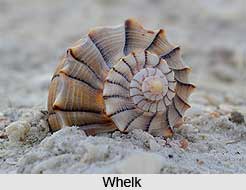
 Whelk is a large group of gastropods of various forms. They are all inhabitants of the sea and their shells are mostly shaped like a top or like a spindle or pear. They are all carnivorous and burrow in mud in search of the bivalves which they eat. They haunt littoral rocks, reefs and mud-flats, drill bivalve shells and rasp out the flesh with their radula. All whelks are characterized by a mouth situated at the end of a long proboscis which can be with drawn into the cavity of the head. The radula is composed of only a few teeth in each row (total number only 220 to 250 whereas in a snail it is 30,000); but the teeth are large and often strongly serrated, well adapted to rasp shells or tear flesh. Like all carnivorous molluscs, whelks possess salivary glands opening into the throat which secrete sulphuric acid. This acid saliva softens the shell under attack and also aids digestion. Whelks are abundantly found in the Indian seas.
The sexes are separate in all whelks. Fertilization is internal. Eggs are laid in parchment-like capsules, in which is contained in addition to the eggs some quantity of albumin serving to nourish the embryos. The shape of the capsules varies in different genera; it is coin-like in typical whelks, flattened pouches in Nassa, grain-like in Purples and triangular in Murices. Sometimes the capsules are stalked, sometimes without stalks (sessile). Sometimes the capsules have lids which open to let the embryos out. Generally large numbers of these capsules (each capsule containing a varying number of eggs) are attached to a gristly thread or sheet which is fixed to a rock, seaweed or similar object. Often only a limited number - sometimes only one - of the embryos contained in each capsule becomes developed, the rest serving as nutriment for the survivors.
True Whelks belong to the family Buccinidae. Several kinds are abundant on the sand-covered mud-flats, in rock pools and among the stones on Indian coasts Babylonia spirata is the commonest and most beautiful of Indian whelks. The line joining two consecutive whorls is deeply sunk in a groove so that the spiral whorls look as though they are telescopically fitted. The shell mouth is broad and the outer lip is thin. The animal feeds on bivalves. When it moves gracefully over sand or rock its elongated flat foot, the prominent proboscis and head with tentacles, can all be seen clearly. Several species of Cantharus and Pollia are also abundant. Whelks are available in large quantities in the Indian seas.