


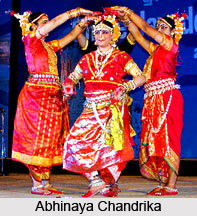
 A fairly large number of texts related to music and dance were written in Orissa. Sangeeta Kaumudi and Abhinaya Chandrika were the two early works which were written during the 15th century and all other works were mostly written during 17th and 18th centuries. Most of the verses were written in Sanskrit Language and bear eloquent testimony to the fact that there was a wide culture of dance and music in the region, only one of the verses is written in Oriya Language. Unfortunately only few of them have been published and the rest are still in the form of palm-leaf manuscripts. Some of the well known treatises of Odissi Dance are Abhinaya Chandrika, Natya Manorama, Sangeeta Narayana, Sangeeta Muktavali, Abhinaya Darpana Prakash, Sangeeta Kaumudi, Sangeeta Kalpalata and a few others. A fairly large number of texts related to music and dance were written in Orissa. Sangeeta Kaumudi and Abhinaya Chandrika were the two early works which were written during the 15th century and all other works were mostly written during 17th and 18th centuries. Most of the verses were written in Sanskrit Language and bear eloquent testimony to the fact that there was a wide culture of dance and music in the region, only one of the verses is written in Oriya Language. Unfortunately only few of them have been published and the rest are still in the form of palm-leaf manuscripts. Some of the well known treatises of Odissi Dance are Abhinaya Chandrika, Natya Manorama, Sangeeta Narayana, Sangeeta Muktavali, Abhinaya Darpana Prakash, Sangeeta Kaumudi, Sangeeta Kalpalata and a few others.
While Abhinaya Chandrika is an ancient text on Odissi dance Natya Manorama was published in the year 1959. The latter is a treatise on the science of music and dance. It has been published by the Orissa Sahitya Akademi, Bhubaneshwar in the year 1959 and is based on a palm-leaf manuscript preserved in the Orissa State Museum. From the concluding verse of the treaty it can be well be inferred that the treatise was written under the patronage of King Nilakantha of Kerala. 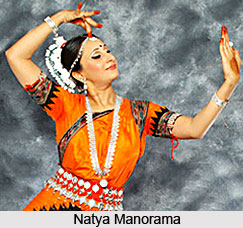
Among all the texts on music and dance written in Orissa, Sangeeta Narayana seems to be the most systematic work. The text was written during the 17th century by Gajapati Narayanadeva. The whole text is divided into four chapters. The first chapter deals with the technicalities of Indian music such as Nada, Swam, Grama, Murchhana, and Ragas and Raginis. The second chapter (Vadya Prakarana) deals with different kinds of drums and other musical instruments giving legitimate space to the most important instrument then in use mainly flute and Mardala. In his description the author closely follows Natyashastra and refers to Bharata many times. The third chapter is the largest and deals with dance alone. This is the most valuable chapter of this work. But the merit of the author lies in the fact that, besides the general technique he has incorporated the details of the local technique peculiar to Odissi dance. In the concluding chapter the author provides notation of a number of Sanskrit as well as Oriya songs mentioning ragas and talas of each song. Sangeeta Muktavali is a small treatise on music and dance. The first chapter of the text describes the technicalities of music such as Nada, Swam, Murchana etc. The second chapter deals with Ragarupa Nirupana while the third gives a clear account of Naba Talas, that is, Adi, Jati, Nisaru, Adda, Triputa, Rupaka, Jhampaka, Mantha and Ektali. All these talas are strictly followed both in Odissi music and dance. The fourth and the last chapter are written about Geeta, Vadya and Nritya. Abhinaya Darpana Prakashis one of the most important treatises on dance written in Orissa. It fully discusses about the technicalities of dance alone. Some of the other treatises on Odissi dance are Sangeeta Kaumadi and Sangeeta Kalpalata. Besides these there are a considerable number of palm-leaf manuscripts on dance and music which has still been preserved in Orissa. Apart from these, there are other treatises on Odissi dance as well. Many of these treatises are found in the form of palm leaf manuscripts. Books, such as, Geeta Prakash by Krishnadas Badajena Mohapatra, Sangeeta Kamoda by Damodara Acharya, Sangeeta Ratna by Narayana and others are worth mentioning. Such texts have contributed immensely in establishing the origin, developments and styles of Odissi dance. |
| |||



Treatises on Odissi
| Treatises on Odissi have given a vivid description of the technicalities and art form that is involved in the dance. The treatises are also a good source of reference for knowing the detailed history of Odissi Dance. |
| ||||||||||||||||||||||||||||

