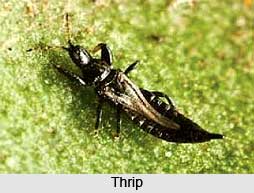
 Thrip is mostly small (0.5 to 14 millimetres long) unnoticed insect with delicate, `fringed` wings, brown or black or yellow in colour generally. This insect occurs in colonies, which, if large, betray their presence. More than two thousand species (of which four hundred or more are from India) have so far been describer but there certainly remain an almost equal number to be collected and described. The Thysanoptera are dominantly tropical or subtropical in distribution, though the temperate regions do have a distinctive fauna, some being also found in the polar areas of the world. Among Indian insect groups, the thrips have had considerable attention paid to them recently and are pretty well known in the Indian subcontinent.
There are two major suborders of thrips which are recognized: the Tubulifera and Terebrantia. The Terebrantia are plant and animal feeding and lay eggs inside plant tissue and pupate in soil. The females have a saw-like ovipositor and these thrips carry their wings side by side along the upper surface of the abdomen when resting. The predacious forms are mostly inquilines while the plant-feeding ones sometimes form galls. The Tubulifera, as they are called, have the last segment of the abdomen tubular and lack an ovipositor. Their wings are kept folded one over the other above the abdomen when resting. These are extremely diverse in form and habitat and many produce gall-like structures on the host plant. These insects lay their eggs on the plant surface and a number of species have their staple food as fungi.
Apart from rasping and sucking plant tissues, feeding on fungi and on a number of other small insects and mites, thrips also inhabit flowers and are therefore considered to be potential pollinators in some cases. Just one flower may hide several small Terebrantia which feed on pollen. Many species assume pest status and the common Indian thrips that cause crop loss are Thrips tabaci (on cotton), Scirtothrips dorsalis (chilli), Baliothrips biformis (paddy) and Rhipiphorothrips cruentatus (groundnut). The common gall-forming thrips are Arrhenothrips ramakrishnae which cause the familiar leaf galls on Mimusops elengi (bulletwood) and Gynaikothrips karnyi on pepper.