


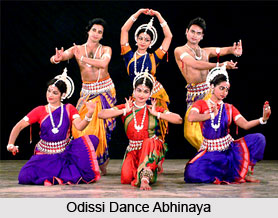
 The style of Odissi may be seen as a combination of appreciative and technical details. This dance style is characterized by flowing of the upper body and gracefulness in gestures and wristwork, adjoining with firm footwork. The rhythmic dances of Odissi are called Batu Sthayi (foundation), pallavi (flowering), and Moksha (liberation). The acting dances are called abhinaya. Odissi is an expressive and sophisticated art form, which features poetic touch and imaginary storytelling. The style of Odissi may be seen as a combination of appreciative and technical details. This dance style is characterized by flowing of the upper body and gracefulness in gestures and wristwork, adjoining with firm footwork. The rhythmic dances of Odissi are called Batu Sthayi (foundation), pallavi (flowering), and Moksha (liberation). The acting dances are called abhinaya. Odissi is an expressive and sophisticated art form, which features poetic touch and imaginary storytelling.
Style of Odissi dance has a complete equilibrium of the sama pada position which marks the beginning of the performance. The sama pada is followed by the next characteristic pose of Odissi dance known as the chowka. It is a rectangular position in which the weight of the body is equally divided, but there is a four tala distance between the two feet. The square is the basic geometrical motif where an attempt is made to weave complete or partial figures of eight. The fundamental poses of the dance style are the Minadandi, bartula, Ghera and dvimukha. These names are pointers to the manner of covering space. The Minadandi indicates the semicircular posture in which the space may be covered by the lower half of the leg. Ghera is a movement in concentric circles where the dancer gradually enlarges the space covered from a small inner circle to other enlarged concentric circles. The dvimukha is a complete extension of both legs which is peculiar only to the Odissi dance. These positions and basic movements are reinforced by various forms of sitting, walking, leaping and elevations and so on. The sitting positions are reminiscent of the karana positions of the Natyashastra. Various forms of walking known as the chalis are a direct derivation from the charis of the Natyashastra. Earthly and the sky types are used. Odissi itself has devised many such charis including the ekapada charis and dvipada charis or two-leg movements. These movements provide one of the most exquisite ways of covering space by walking to the front or back, as well as in a circle by diagonal walking. The weaving of patterns in spirals along a vertical line in space is a special feature of these movements. The spiral is achieved by manipulating the calf. Movements of the leg, from knee to foot merge these patterns in space and the upper body remains almost static. The final position is invariably statuesque. In these charis the dancer maintains a slight outward bent position of the knees. There are many elevations in the style of Odissi. This dance style preserves the largest variety of elevations and jumps of the Natyashastra tradition and is known as utha in Odissi dance. Clockwise and anti-clockwise Bhramaris are also common and is known as Bhramari in Odissi dance. The karanas are often seen in Odissi and are called bhangis. In the bhangis of Odissi there is a deliberate attempt to make a languorous extension of the torso. The advaita torso movement is typical and along with the relaxed dola hasta and the kari hasta gives the dance style a unique grace of its own. The combination of precision with grace gives the dance style its individual character. Mostly these Bhangis are based on the Tribhanga concept of Hindu iconography. This feminine pose is most approved with three bends in the body. The first caused by the crossing of the legs, the second caused by a curvature at the waist and the third by an inclination of the head to one side generally to the left. This is esteemed the most amatory and graceful, and dancing girls are often represented with these or similar bends. The Odissi classification of the different types of positions movements and stances distinguishes it from the traditions of Natyashastra and Abhinaya Darpana Prakash. The leg movements play an important role in Odissi dance. The bhumis are ways of covering space and can be identified as the gatis of Abhinaya Darpana. The sitting posture is known as Baitha, the standing postures are the sthanakas, the walking is the chali, and the running is the burha. Bhasa is shifting of weight by swaying the body from one side to the other. There are several bhangis of Odissi and may be identified as sthanas. Most of these are static positions. In its entire movements attempt is always made to bring out an elaborate grace and charm. In some items sharp and measured movements predominate whereas in some items movements are soft and lyrical. All these combine to build up the consummate artistry, the elaborate grace and charm which remain and fundamental characteristics of Odissi. |
| |||



Style of Odissi
| Style of Odissi dance maintains a perfect balance between physical, mental and spiritual aspects of dance. |
| ||||||||||||||||||||||||||||

