





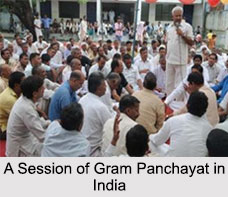
 Rural local self government in India comprises of Indian administrative bodies, which are managed only by the local people in rural areas to solve certain local problems efficiently. More than 80 percent of the Indian population lives in villages and the welfare of the people implies an all-round improvement of the Indian villages. Thus, the quality of rural local self government plays an important role in the developments brought about in the rural areas in India. Rural local self government in India has been very meticulous in bringing about developments in the villages. Rural local self government in India comprises of Indian administrative bodies, which are managed only by the local people in rural areas to solve certain local problems efficiently. More than 80 percent of the Indian population lives in villages and the welfare of the people implies an all-round improvement of the Indian villages. Thus, the quality of rural local self government plays an important role in the developments brought about in the rural areas in India. Rural local self government in India has been very meticulous in bringing about developments in the villages.
History of Rural Local Self Government in India Decentralization of power is the basic principle of democracy. Democratic socialism is impossible unless the social structure, the administrate machinery and the economic organization of a country are based upon decentralization of power. The rural self-governing institutions introduced in India by the British rulers were reconstituted and revitalized, so that through the agencies of these newly-formed institutions, the rural people may be increasingly associated with the task of planning for development. The foundation of a welfare state was strengthened by the participation of the local people in the administration of local affairs affecting their common interests. Types of Rural Local Self Government in India Three types of rural local self-governing institutions have been created in India to look after the affairs of rural areas. These institutions are the Gram Panchayat, Panchayat Samiti and Zilla Parishad. Gram Panchayat Gram Panchayat is a local government at the level of villages and small towns. In fact, the Gram Panchayat is the foundation of the Panchayati System in India. A Gram Panchayat is formed in a village, which has a population of 300 or more than 300. It can also be formed in a conglomeration of two or more villages. ‘Sarpanch’ or the Chairperson heads a Gram Panchayat. The main function of a Gram Panchayat is to look after the basic amenities of the villages, under the surveillance of the Sarpanch. Gram Panchayat earns its income from the taxes levied on various open spaces and various other properties of the villages. Panchayat Samiti Panchayat Samiti has taken the place of the former Anchalik Parishad and is the second tier under the new system. Every district is divided into a number of blocks, consisting of several neighboring villages. For each block, there is one Panchayat Samiti of which the Block Development Officer (BDO) acts as an ex-officio executive officer. A Panchayat Samiti is responsible for collecting all the potential plans prepared at the level of Gram Panchayat. It then analyses the plans with respect to financial constraints, social welfare and area development in order to generate funds for their execution. Zilla Parishad Zilla Parishad looks after the administration of rural areas in a district. The office of the Zilla Parishad is located in the district headquarters. The ex-officio secretary of the Zilla Parishad is the Deputy Chief Executive Officer from General Administration Department present at the district level. The main function of this governing body is to provide essential facilities to the rural people and to initiate the development programmes in the villages. |
| ||||||||||||||||||||||||||||

