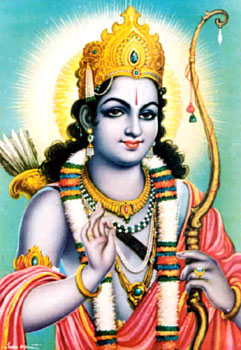
 Rama as heir apparent or the most probable heir to the throne of Ayodhya was described elaborately in the beginning of the Ayodhya Kanda in Ramayana. Dasharatha reflected that he had ruled for many years, and was weary, and he thought no joy could be greater than if he should see Rama established on the throne. He summoned a council of his vassals and counselors and neighbouring kings and princes who were accustomed to reside in Ayodhya, and in solemn words, like the thunder of drums, addressed that he wants his son Rama as heir-apparent and entrust the government to him.
He addressed to the gathering of all great and noble men that for many years he had ruled the realm, being a father to those that dwell therein. He ruled the subjects strictly according to the dharma and never thought of his own happiness at the cost of others. He thus wants to take rest, and like his elder son Rama to be instilled as the heir-apparent and entrust the government to him and he asks for the approval of the people present there. The princes rejoiced at the king`s words, as peacocks dance at the sight of heavy rain-clouds. There arose the hum of many voices, as for a time the Brahmans and army-leaders, citizens and countrymen considered together. Then they answered to Dasaratha they are very much eager to see Rama installed as heir-apparent, riding the elephant of state, seated beneath the umbrella of dominion.
The old king Dasaratha again inquired of them for greater certainty and asked why they want Rama as their rule and in reply the princes replied that Rama possessed several virtues, for indeed he towers among men as Sakra amongst the gods. In forgiveness he is like the Earth, in debate like Brihaspati. He speaks the truth, and is a mighty bowman. He is ever busied with the welfare of the people, and not given to detraction where he finds one blemish amongst many virtues. He is skilled in music and his eyes are fair to look upon. Neither his pleasure nor his anger is in vain; he is easily approached, and self-controlled, and goes not forth to war or the protection of a city or a province without victorious return. He is beloved of all. Indeed, the Earth desires him for her Lord.
After hearing this, the King was utterly delighted and called upon Vashishtha, Vamadeva, and other Brahmans, and charged them to make ready for Rama`s installation. Orders were given for the purveyance of gold and silver and gems and ritual vessels, grains and honey and clarified butter, cloth as yet unworn, weapons, cars, elephants, a bull with gilded horns, a tiger-skin, a scepter and umbrella, and heaped-up rice and curds and milk for the feeding of a large number of people.
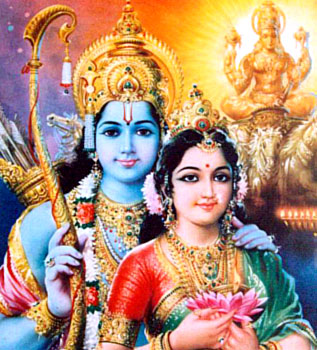 Flags were hoisted, the roads were watered, garlands were hung on every door; knights were notified to be present in their mail, and singers and dancers to hold themselves in readiness. Then Dasharatha sent for Rama, that long-armed hero, like the moon in beauty, and gladdening the eyes of all men. Rama passed through the assembly, like a moon in the clear starry autumn sky, and bending low worshipped the feet of his father. Dasharatha lifted him and set him on a seat which was previously prepared for him, golden and begemmed, where he seemed like an image or reflection of his father on the throne. Then the aged king spoke to Rama of what had been decided, and announced that he should be installed as heir-apparent.
Then friends of Kaushalya, the mother of Rama, told her all that had been done, and received gold and kine and gems in reward for their good tidings, and all men with delighted minds decorated and repaired their homes and worshipped the gods.
Then again the king sent for Rama and held converse with him. He informed him that he is going to install him as the heir-apparent since he has grown old and had dreamt ill dreams and the astrologers informed him that his life-star is threatened by the planets Sun and Mars and Rahu. Thus, he asked Rama, along with Sita, to observe a fast from sunset. Then Rama left his father and looked for his mother in the inner rooms. He found her in the temple, clad in silk, worshipping the gods and praying for his welfare. There, too, were Lakshman and Sita. Rama reverenced his mother, and asked her to prepare whatever should be necessary for the night of fasting, for himself and Sita. Turning then to Lakshman, asked him to rule the earth with him since it was his good fortune which is as good as his own. Then Rama went with Sita to his own quarters, and Vashishtha also went to bless the fast.
All that night the highways and streets of Ayodhya were crowded with eager men; the tumult and the hum of voices sounded like the roar of the ocean when the moon is full. The streets were cleaned and washed, and hung with garlands and strings of flags and banners; lighted lamps were set on branching cressets. The name of Rama was on the lips of every man, and all were expectant of the morrow, while Rama kept the fast within. Thus, the declaration of Rama as heir-apparent by Dasaratha and the grand preparation for the installation of Rama as the King of Ayodhya are narrated well in the starting of the Ayodhya Kanda.