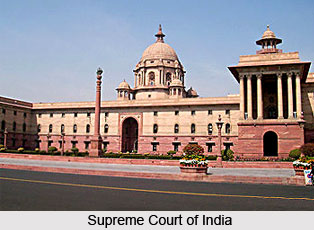
 The Government of India enacted the National Commission for Backward Classes Act, 1993 (Act No. 27 of 1993) for setting up a National Commission for Backward Classes as a permanent body. The Act came into effect on the 2nd April, 1993. Section 3 of the Act provides that the Commission shall consist of 5 Members, comprising of a Chairperson who is or has been a judge of the Supreme Court of India or High Courts in India; a social scientist; two persons, who have special knowledge in matters relating to backward classes; and a Member-Secretary, who is or has been an officer of the Central Government in the rank of Secretary to the Government of India. The Government of India constituted the Commission on 14th August 1993 with a term of 3 years, by its Notification No. 12011/34/BCC/Pt. The Commission was subsequently re-constituted on 28.2.1997 and 28.7.2000. Article 340 of the Constitution provides for the appointment of a Commission to investigate the conditions of and the difficulties faced by the socially and educationally backward classes and to make appropriate recommendations.
Appointment of National Commission for Backward Classes
Grounds on which the National Commission for Backward Classes may be appointed are-
(1) The President of India may by order appoint a Commission consisting of such persons as he thinks fit to investigate the conditions of the socially and educationally backward classes within the territory of India and the difficulties under which they labour and to make recommendations as to the steps that should be taken by the Union or any State to remove such difficulties and to improve their condition and as to the grants that should be made for the purpose by the Union or any State and the conditions subject to which such grants should be made, and the order appointing such Commission shall define the procedure to be followed by the Commission.
(2) A Commission, so appointed, shall investigate the matters referred to them and present to the President a report stating the facts as found by them and make appropriate recommendations.
(3) The President shall cause a copy of the report so presented together with a memorandum explaining the action taken thereon to be laid before each house of Parliament.
Functions of the National Commission for Backward Classes
* Under Section 9(1) of the National Commission for Backward Classes Act, 1993, the Commission shall examine requests for inclusion of any class of citizens as a backward class in the Central List of Backward Classes and hear complaints of over-inclusion or under-inclusion of any backward class in the lists and tender such advice to the Union Government as it deems appropriate.
* Under Section 9(2) of the Act, The advice of the Commission shall ordinarily be binding upon the Central Government.
* Under Section 11(1) of the Act, the Central Government may at any time, and shall, at the expiration of 10 years from the coming into force of this Act and every succeeding period of ten years thereafter, undertake revision of the lists with a view to excluding from such lists those classes who have ceased to be backward classes or for including in such lists new backward classes.
* Under Section 11(2) of the Act, the Central Government shall, while undertaking any revision referred to in sub-section (1) consult the Commission.
The Government of India has also evolved the criteria for exclusion of certain socially advanced persons and sections- called the Creamy Layer - from the benefits of reservation available to OBCs in civil posts and services under the Government of India.