


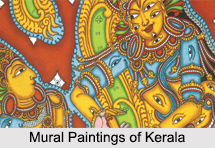
 Mural Paintings of Kerala dated back to the 7th and 8th century AD. It is very clear that the early Mural Paintings in Kerala were heavily influenced by the Pallava style of art. The earliest Mural Paintings of Kerala were found in the rock-cut cave temple of Thirunandikkara, which is presently in the Kanyakumari District of Tamil Nadu. Mural Paintings of Kerala dated back to the 7th and 8th century AD. It is very clear that the early Mural Paintings in Kerala were heavily influenced by the Pallava style of art. The earliest Mural Paintings of Kerala were found in the rock-cut cave temple of Thirunandikkara, which is presently in the Kanyakumari District of Tamil Nadu.
The murals of these places are reckoned as the earliest specimens of Kerala painting. At the same time it can be said that the Kerala Murals were also heavily influenced by the Dravidian style and the form of art involved sprinkling of coloured powders into the outlined sketches of various art forms. History of Mural Paintings of Kerala The oldest murals in Kerala were found in Thirunandikkara which comes under Tamil Nadu state at near and the murals at Tiruvanchikulam. These paintings were supposed to be done in the 9th and 10th century. Throughout the 10th century a mural painting consists of the writing of Goda Ravi Barman which was seen in the Cheruthuruthy Tali temple in Thrissur. Tradition says that the Kerala Murals or paintings on walls were headed by pre-remarkable rock paintings which were found in the Anjanad Valley of the Idduki District. Archaeologists have found out that such paintings in Kerala dated back to the Palaeolithic as well as the Mesolithic Periods. Most of the Mural Paintings which are found till date in Kerala dates back to the 15th century and presently only sketchy outlines of those paintings exist and not the heavily decorated forms. Kerala has a rich tradition in the field of painting as is evidenced by the murals in temples, palaces and churches. Themes and depiction of Mural Paintings of Kerala 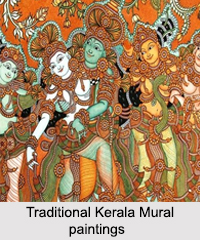 The themes of Kerala Murals are spiritual and religious texts mostly. The paintings show highly stylized forms of Hindu gods and goddesses along with some Dhyana slokas written beside them. A lot of flora and fauna are also represented in the Mural Paintings of Kerala. It is said that murals of Kanthaloor temple in Thiruvananthapuram district and those at Pardhivapuram and Trivikramapuram in Thiruvananthapuram are the oldest existing temple frescoes of Kerala. Widespread murals depicting scenes from the Hindu epics, the Ramayana and the Bhagavatha are conserved at the Mattancherry Palace in Ernakulam district. The murals of the Shiva Temple at Ettumanoor offer insights into the earliest forms of Dravidian mural art. The themes of Kerala Murals are spiritual and religious texts mostly. The paintings show highly stylized forms of Hindu gods and goddesses along with some Dhyana slokas written beside them. A lot of flora and fauna are also represented in the Mural Paintings of Kerala. It is said that murals of Kanthaloor temple in Thiruvananthapuram district and those at Pardhivapuram and Trivikramapuram in Thiruvananthapuram are the oldest existing temple frescoes of Kerala. Widespread murals depicting scenes from the Hindu epics, the Ramayana and the Bhagavatha are conserved at the Mattancherry Palace in Ernakulam district. The murals of the Shiva Temple at Ettumanoor offer insights into the earliest forms of Dravidian mural art.
The Murals in the churches of Kerala also reveal stories from the Christian Mythology. The paintings of Virgin Mary in the churches at Edappalli and Vechur are of profound religious significance to the devotees. Further, the outer walls of the Kanjur church have a huge mural which depicts the scene of a battle fought between the armies of Tipu Sultan on one side and those of the British East India Company, aided by the barefooted local militia, on the other. Another important subject matter of Kerala Murals was stories from epics like Ramayana. Mural Painting in Kerala is so developed that it holds second place in the country, the first being Rajasthan. The palaces at Padmanabhapuram, Kayamkulam and Mattancheri are famous for its Mural Paintings. The temples of Kerala famous for its Murals are Panayannarkavu, Pundareekapuram, Pandavam, Thrissur, Chemmanthitta, Kaliampally and Thodeekkalm. The murals in the Sri Padmanabha temple, Trivandrum, depicting Puranic themes are noted for their remarkable finish and grace. The Vishnu temple at Thrikkodithanam, the Shiva temples at Ettumanoor and Vaikom, the Subramonia temple, Udayanapuram, the Vadakkunathan temple, Thrissur, the Krishna temple, Triprangode are among many temples of Kerala which contain exquisite mural paintings. Panayannarkavu Temple in Kerala is well known because it is one of the few temples in the state which depict murals all along the Sapta Matas or the Seven Mother Goddess which is the presiding god of the temple. A close view of the Murals in this particular temple represents a Vaishnavite Tradition. The Murals in this temple is known for its accuracy. The Murals in Mattancheri in Kochi has a specific feature of trade and commerce even today. |
| |||



Home > Art & Culture > Indian Paintings > Types of Indian Painting > Indian Mural Paintings > Dravidian Mural Painting > Mural Paintings of Kerala
Mural Paintings of Kerala
| Mural Paintings of Kerala occupy a prominent place of pride. The murals in temples, palaces and churches add to its glory. Most of the Mural Paintings of Kerala temples belong to the period dating back to 15th century AD onwards. |
| ||||||||||||||||||||||||||||

