Mantid
|
Mantid is usually a large insect which is mainly predacious. In India there are about two hundred species of mantids.
|
|
|
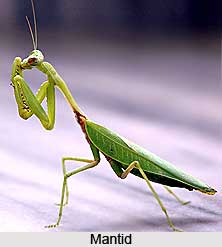 Mantid is solitary, strictly predacious, generally large insect with raptorial fore legs, usually held in a peculiar supplicatory posture, popularly known as 'praying mantid'. These insects are restricted to the warmer parts of the world where more than 1800 species exist. The Indian fauna possibly numbers around two hundred species, many of them being very cryptically coloured, green or brown and similar to the type of shrub, herb or tree-trunk they inhabit. They usually stalk prey or lie in wait for them, lashing out with their fore legs armed with spines to capture and hold the smaller insects while feeding on them. Adult mantids are not capable of strong flight, even though they do possess well-developed wings (in some species the hind wings being strikingly coloured). The females of most species are flightless and usually devour the hapless, smaller male after he copulates with her. Mantid is solitary, strictly predacious, generally large insect with raptorial fore legs, usually held in a peculiar supplicatory posture, popularly known as 'praying mantid'. These insects are restricted to the warmer parts of the world where more than 1800 species exist. The Indian fauna possibly numbers around two hundred species, many of them being very cryptically coloured, green or brown and similar to the type of shrub, herb or tree-trunk they inhabit. They usually stalk prey or lie in wait for them, lashing out with their fore legs armed with spines to capture and hold the smaller insects while feeding on them. Adult mantids are not capable of strong flight, even though they do possess well-developed wings (in some species the hind wings being strikingly coloured). The females of most species are flightless and usually devour the hapless, smaller male after he copulates with her.
The female deposits several eggs in a typically shaped ootheca very similar to, though more elegant than, the egg-cases of the related cockroaches. They are attached to the tree-trunks, stems, to rocks or walls or in soil or grass. Each such ootheca may contain from ten to five hundred eggs and in some species the female may guard it until the young hatch. The oothecae are subject to attack by small proctotrupoid or chalcidoid wasps and mantid densities are generally limited by such parasites and by the cannibalistic habits of newly hatched nymphs (as of mating adults). There appears to be some sort of territorial behaviour in many mantids. Being general predators on any suitable insect or spider prey, they cannot be classed as 'beneficial' predators in the agricultural or forest ecosystem, but they are, undoubtedly, a more beneficial than harmful insect order.
Species of Empusa are a common type of mantid found in the Old World tropics. The very strikingly Gongylus gongyloides, Phyllothelys and Sphendale, are typically Indian in distribution. Hierodula westwoodi and Schizocephala bicornis are the commonly noticeable species in cultivation on the plains.
This article is a stub. You can enrich this article by adding more information to it. Send your write up at www.content@indianetzone.com
|
|
|
|





