|
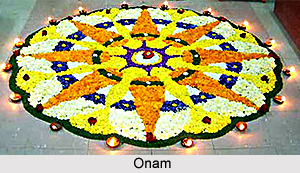
 Legends of Onam speak of the reason for celebration of the famous festival of Kerala. Onam is the great fertility rite of the year, the ceremony of gratitude for the never-failing fruits of a tropical climate, but it also a festival that re-enacts one of the most important legends of the Malayali people. On the eve of Thiru Onam, the second day of the festival, ziggurat-like structures of flowers are placed in the entrances to Keralan houses; these are intended to welcome, on his annual return the following morning from the underworld, the legendary king Mahabali, who ruled over Kerala in the golden age before caste existed, when all men were equal no man was poor, and there was neither theft nor dread of thieves. Legends of Onam speak of the reason for celebration of the famous festival of Kerala. Onam is the great fertility rite of the year, the ceremony of gratitude for the never-failing fruits of a tropical climate, but it also a festival that re-enacts one of the most important legends of the Malayali people. On the eve of Thiru Onam, the second day of the festival, ziggurat-like structures of flowers are placed in the entrances to Keralan houses; these are intended to welcome, on his annual return the following morning from the underworld, the legendary king Mahabali, who ruled over Kerala in the golden age before caste existed, when all men were equal no man was poor, and there was neither theft nor dread of thieves.
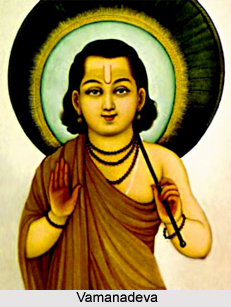
The story of Mahabali is a peculiarly Keralan and non-Brahminical adaptation of the story of the fifth incarnation of Lord Vishnu. In the orthodox version, which dates back to the Rig Veda, long before the cult of Vishnu reached South India, Mahabali appears as the demon king Bali, of the race of the Asuras, who becomes a yogi so powerful in his magic that he gains control over the earth, and even the gods feel themselves threatened. The Lord Vishnu is deputed to save the Brahminical deities from this titanic magician, and he assumes the form of the pathetically ugly and comical dwarf Vamana, who one day appears before Bali as a holy beggar and asks a boon - the gift of as much land as he can cover in three paces. When Bali unsuspiciously agrees, Vamana begins to stride, and even as he makes the first step he grows into a being so gigantic that in his three paces he encompasses the whole earth, and the demon king Bali is forced to retreat to the infernal region, the only kingdom that is left to him.
 In Kerala the whole perspective of this ancient legend has changed, for Bali becomes Mahabali, the Great Bali, who ruled his realm so well that he aroused the jealousy rather than the fear of the gods, and who gave up his kingdom, not because he was the victim of a trick, but because he was too generous to refuse a request and too honourable not to fulfil a promise. As he withdrew into the underworld, victim of the malice of the gods, he asked one boon for himself, which was granted: that on a single day each year he might be allowed to return and to see how his beloved children, the Malayans, were faring. That day is Thiru Onam, and Mahabali's ghostly but amiable presence is greeted by a special feast of boiled bananas and by the exchanging of gifts, while in the king's honour the girls put on white skirts and coloured blouses, and dance with flowers in their hair.
At the same time the Nayars, the traditional warrior caste of the Malabar Coast, stage sword-fights, and in the wide backwaters the young men race the great snake-boats, the chundan valloms, with their tall ornamental sterns and their hundred paddlers, whose very name and form look back to the age when the gods of the Brahmin were still unknown in Kerala and the people worshipped the Nagas, the serpent deities who lived, like King Mahabali, in the underworld.
But there is another aspect to the Onam festival than either forgotten history it revives or the universal symbols of fertility with which it links Mahabali and his legend. To the educated Malayalis Mahabali is no more a figure of past or present reality than Santa Claus is to us. Yet they still celebrate his festival as richly as they can afford, partly because of the sentiments of brotherhood and good fellowship which the idea of Onam, like the idea of Christmas, generates, but also with an almost magical feeling that in some way what they do on the day when Mahabali returns may bring a gleam of his golden age into a time in which, for most Keralans, life shows its feet of clay.
|





