Hydra
|
Hydra is a very tiny freshwater animal bearing radial symmetry. It possesses great power of regeneration and if cut into pieces it grows into new wholes.
|
|
|
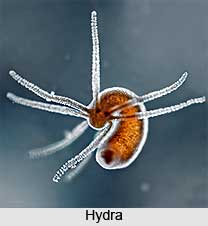 Hydra is a very small, solitary polyp not exceeding six millimetres in length. It lives in ponds and rivers attached to stones and weeds. Under a lens it looks like a short tube fixed at one end by a sticky disc and the other end free and conical. The cone is called the hypostome or manubrium, at the summit of which is the mouth leading into the cavity of the tube - the gastro vascular cavity - where digestion of food takes place. Surrounding the base of the hypostome is a circlet of thread-like tentacles armed with stinging cells. Each tentacle has numerous such cells each of which contains a coiled whip bathed in a poisonous fluid. At the slightest pressure the cell bursts out and shoots the whip, piercing the prey. The tentacles can extend, capture prey and take the food into the mouth. Hydra is a very small, solitary polyp not exceeding six millimetres in length. It lives in ponds and rivers attached to stones and weeds. Under a lens it looks like a short tube fixed at one end by a sticky disc and the other end free and conical. The cone is called the hypostome or manubrium, at the summit of which is the mouth leading into the cavity of the tube - the gastro vascular cavity - where digestion of food takes place. Surrounding the base of the hypostome is a circlet of thread-like tentacles armed with stinging cells. Each tentacle has numerous such cells each of which contains a coiled whip bathed in a poisonous fluid. At the slightest pressure the cell bursts out and shoots the whip, piercing the prey. The tentacles can extend, capture prey and take the food into the mouth.
The body wall of hydra is of two layers - the outer one protective and inner one digestive. The wall is firm and muscular and the animal can stretch or contract its body. It can also move slowly from place to place by looping. From the normal erect position to animal bends like a horseshoe until the tentacles touch the ground. Holding the ground firmly with the arms, it releases the basal disc and contracts. Then it stretches its body, bends in another direction and fixes the disc at a convenient point. Then releasing the free end it assumes its normal form. Thus it moves like a measuring worm. Some species move by gliding the basal disc slowly.
From the attached position a hydra can hold or adjust its body in such a way as to secure maximum oxygen and food supply. A hydra living at the bottom of a tank stands erect; attached to the side of a piling it grows horizontally; and if on floating weeds it hangs directly downwards.
Some hydras are symbiotic: green algae live in their cells and feed on the waste of the hydras which in their turn receive a copious supply of oxygen from the photosynthetic activity of the algae. Hydras have great power of regeneration. Even if cut into pieces each part develops into a whole. Biologists have produced hydras with many heads by grafting pieces of a cut animal to the trunk of a living hydra.
|
|
|
|





