


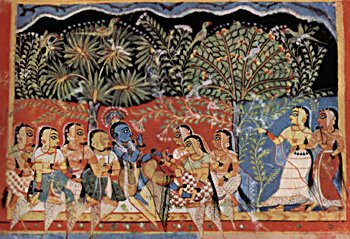
 Geeta Gobinda has served as a major treatise of the Bhakti Movement in the Hindu tradition. It has been divided into twelve chapters which have further been subdivided into twenty four parts known by the name Prabandha. In Geeta Gobinda the author has tried to combine the religious fervour with eroticism. The piece of writing belongs to medieval Vaishnavism and describes the love sports of Radha and Lord Krishna and also the pangs of separation between the two lovers. It is true that on the surface the poem Geeta Gobinda expresses the feeling of love between the two lovers but deep down it conveys the ethos of devotion of individual soul. It tries to express the realisation of God in every soul. Geeta Gobinda has served as a major treatise of the Bhakti Movement in the Hindu tradition. It has been divided into twelve chapters which have further been subdivided into twenty four parts known by the name Prabandha. In Geeta Gobinda the author has tried to combine the religious fervour with eroticism. The piece of writing belongs to medieval Vaishnavism and describes the love sports of Radha and Lord Krishna and also the pangs of separation between the two lovers. It is true that on the surface the poem Geeta Gobinda expresses the feeling of love between the two lovers but deep down it conveys the ethos of devotion of individual soul. It tries to express the realisation of God in every soul.
It says that final consummation is achieved only in the service of God. At the end of the poem, the poet himself has said that the poem was a prop for the meditation of Lord Vishnu. Geeta Gobinda very well shows the mastery of the author on music, dance, erotica and the science of love. The poem also explicitly shows the devotion of the poet for Lord Vishnu. Each subdivision or Prabandha is further divided into two other divisions, comprising mostly of eight couplets each and is known by the name ashtapadis. The ashtapadis are preceded and followed by different meters numbering about thirteen. The incorporation of metrics in the poem shows the expertise of the poet in the science of metrics and his choice of words has been appreciated by all. The lyrics of Geeta Gobinda set a devotional tone for the readers as well as listeners. The composition of Geeta Gobinda is known for its religious as well as literary flavour. The tone of the poem gets mingled with cultural ethos of the listener. It has had a profound effect on Oriya Literature. Its tremendous impact moulded the art and literature to a great extent. The music, dance, drama, sculpture, painting, literature and religion had become votaries of this great hymn. Structure of Geeta Gobinda The first canto contains four of the twenty-four Prabandhas, songs, into which the poem is also divided. It exhibits in perfection the multifaceted structure. The poet begins with four verses. In the last verse he celebrates himself and his fellow-poets. The first Prabandha consists of a hymn in eleven stanzas that are sung in the honour of the ten incarnations of Lord Vishnu. It ends with a mention of the author. Each stanza ends with the refrain. The third Prabandha consists of a recited verse telling how Radha's friend spoke to her in the spring. Thereafter in eight stanzas it is mentioned how Lord Krishna is dancing with the cowherds in the groves. Three stanzas follow that describes the spring and ending with the statement that Radha's friend once more addressed her and Prabandha IV consists of a song in eight stanzas. Thereafter three stanzas follow: the first two descriptive and the last one is a benediction. Canto ii speaks of Radha's dejection and gives her song of complaint against her lover followed by a stanza of recitative, introducing another song in which she expresses her deep longing for the god. In Canto iii Krishna is shown in remorse and longing for Radha. Prabandha vii speaks of his song of love. This is followed by verses addressed by him to the god of love and then to Radha herself. The poet closes the canto with a prayer to Lord Krishna as the lover of Radha. In Canto IV Radha's friend addresses Krishna and in two songs depicts the longing of her mistress and her deep grief at separation from her dearly loved. The canto is ended with a benediction. In the next canto Radha's friend urges in three fine songs reconciliation of her mistress with Lord Krishna. However in Canto vii the moon's rising heightens Radha's love. In canto nineteen Krishna himself appears and sings to her. Radha's reluctance and shyness is overcome in three songs by her friend. In the end all is secure at last. The poem closes in a manner in which Krishna addresses his beloved and she replies. In the case of the Geeta Gobinda the art of wedding sound and meaning is carried out very skilfully. |
| |||



Geeta Gobinda
| Geeta Gobinda is a lyrical poem composed by Jayadeva in the 12th century A.D. The composition describes the relationship between Lord Krishna and the gopis of Vrindavan especially with one Gopi namely Radha. |
| ||||||||||||||||||||||||||||

