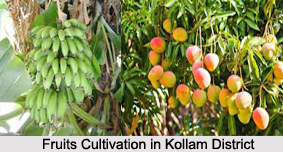
 Economy of Kollam district is primarily dependant on agriculture. The district has a prominent place in the field of agriculture. About 70 per cent of the work force is engaged in agriculture. The total extent of land under cultivation is 2, 18,267 hectares. The major crops grown here are paddy, tapioca, coconut, rubber, pepper, all of which are cultivated in an area of 1, 73,847 hectares. Coconut gardens extend to about 75,454 hectares. About three hundred and forty three million coconuts are produced every year.
Other than that, bananas, mango and cashewnuts are also grown here. In the agricultural scenario, small and marginal farmers constitute more than 95 percent of the farming community and the average per family holding is 0.21 hectare. All the 71 Panchayats of the district are covered by separate Krishi Bhavans. There is an Oil Palm Plantation at Bharatheepuram near Anchal, in an area of 4000 hectares, under the Oil Palm India Ltd., a state government undertaking. The Rehabilitation Plantations, another State Government undertaking, is located at Kulathupuzha near Thenmala.
Kollam is quite important for the trade and commerce of the state. It is the centre of the country`s cashew trading and processing industry. There are 17 large, and one medium scale industry in the district, of which, two are Central Government undertakings. About 1963 SSI units have been registered in the district. Cashew processing and coir production are major industrial vocations of the district. The Kerala State Cashew Development Corporation (KSCDC) is the largest processor of cashewnut in the world. At present, it has 34 factories. K.S.C.D.C. provides employment to more than 26,000 workers. Handloom industry, clay and wood-based industries also contribute to the industrial advancement of the region. Kollam district is also an important hub for the State`s marine products industry, with the port of Neendakara being the centre for trawlers and ice plants.
Kollam district ranks first in livestock wealth in the state. Dairy farming is fairly well developed. Milch cattle are found in quite a sizeable amount here in the district. A network of one district veterinary centre, 2 polyclinics, 48 veterinary dispensaries, 14 veterinary hospitals; and 167 artificial insemination centres, cater to the needs of the district. The number of cows increases annually by five per cent. There are about 65 milk producers` co-operative societies and three chilling plants. The chilling plants are located at Kollam, Kottarakkara and Yeroor. The milk producers` co-operative societies handle about 3.34 lakh litres per day. In poultry, the district stands third and there is great scope for developing broiler and layer poultry farms. The district is covered by the Integrated Dairy Development Project. `Mini-Dairy` Special Project is under implementation, sponsored jointly by MILMA and NABARD.
Kollam is an important maritime district of the state with a coast line of 37.3 kms. Fishing has a prominent place in the economy of the district. Neendakara and Sakthikulangara villages thrive in fishing. An estimated number of 23,000 persons are engaged in fishing and allied activities. Cheriazheekkal, Alappad, Pandarathuruthu, Puthenthura, Neendakara, Thangasseri, Eravipuram and Paravoor are eight among the 26 important fishing villages. There are 24 inland fishing villages also. Considering the unique location and infrastructure available, the Government has initiated steps for establishing a fishing harbour at Neendakara which is expected to augment fish production by 15 percent. Average fish landing is estimated to be 85,275 tonnes per year. One third of the state`s fish catch is from Kollam. There are 93 producer co-operatives, two credit cooperatives and one marketing cooperative in the fisheries sector. There are 38 Fishermen Development Welfare Cooperative Societies in the district. Nearly 3000 mechanised boats operate from the fishing harbour. FFDA and BFFDA are promoting fresh water fish culture and prawn farming respectively. About 60 percent of the production of prawn in the state is from this district.