|
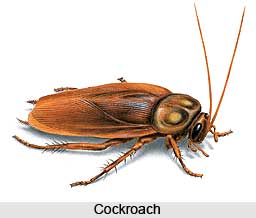 Cockroach is a familiar ground-frequenting insect. It is also the 'scavenger' of the insect world, as it feeds on any kind of dead animal or plant matter. More than three thousand and five hundred species are known all over the world, but it is estimated that this represents only fifty percent of the actual existing species. Periplaneta Americana, P. Australasia Blatta orienralis, Blatella germanica and Supella longipalpa are the common household cockroaches which have now become cosmopolitan (or at least tropicopolitan) with the help of man. They occupy man's houses, stores, markets, and almost any other structure with abundance of food, shelter and the right range of temperature and humidity. Besides eating whatever food is left accessible to them by man, they also spoil stored products with their excreta as well as eat book bindings, container labels and the like. Some species even are known to harbour pathogens like Salmonella and poliomyelitis virus harmful to man. Cockroaches, like rats, are so universally omnipresent around the habitations of man and ecologically so similar, that they are the most important economic and health hazards to man. Cockroaches are found all parts of India. Cockroach is a familiar ground-frequenting insect. It is also the 'scavenger' of the insect world, as it feeds on any kind of dead animal or plant matter. More than three thousand and five hundred species are known all over the world, but it is estimated that this represents only fifty percent of the actual existing species. Periplaneta Americana, P. Australasia Blatta orienralis, Blatella germanica and Supella longipalpa are the common household cockroaches which have now become cosmopolitan (or at least tropicopolitan) with the help of man. They occupy man's houses, stores, markets, and almost any other structure with abundance of food, shelter and the right range of temperature and humidity. Besides eating whatever food is left accessible to them by man, they also spoil stored products with their excreta as well as eat book bindings, container labels and the like. Some species even are known to harbour pathogens like Salmonella and poliomyelitis virus harmful to man. Cockroaches, like rats, are so universally omnipresent around the habitations of man and ecologically so similar, that they are the most important economic and health hazards to man. Cockroaches are found all parts of India.
The majority of cockroaches are nocturnal, hiding in leaf litter, under bark or stones and in thick grass. The diurnal species, however, are found on foliage of trees and shrubs. Most cockroach species are found unconnected with man and some of them, like the Theria petiveriana and Panesthia regalis, are strikingly beautiful species with spots of white or bands of orange on a dark coloured body. The characteristic oothecae or egg-cases are laid by most species, but in some others live young ones are 'laid' by the female or even parthenogenesis (asexual reproduction) is recorded. The life-cycle is long, certainly more than a year in many species. The adult longevity is also protracted, species living for one to four years. Neostylopyga rhombifolia is a common 'rural' species, inhabiting the thatched roofs of huts and breeding in them. The most common 'urban' species, Periplaneta Americana is a 'reliable weather prophet', flying about in houses just before ain fell.
Some species are attracted to light in the nights but most of them are rarely visible, keeping close to soil, seldom venturing out by day. Besides their frog, reptile, bird or mammal predators, cockroaches have many insect, protozoan and helminth parasites that help to keep their populations in check. The Wasp family Evaniidae are specialized parasites of cockroach egg-cases, and several other chalcidoid families attack them. The members of the specid wasp subfamily, Ampulicinae, are also especially fond of adult cockroaches, which these beautifully metallic wasps hunt, sting and drag to their nest-holes. The female wasp lays an egg on the benumbed cockroach, the larvae hatching out completing their life cycle feeding on it.
|





