Caecilian, Amphibian - Informative & researched article on Caecilian, Amphibian
  Indianetzone: Largest Free Encyclopedia of India with thousand of articles History of India


in  
Art & Culture | Entertainment | Health | Reference | Sports | Society | Travel
Forum  | Free E-magazine
History of India : Sources of History of India l Ancient History of India l Medieval History of India l Modern History of India l Indian Historical Dynasties l Indian Battles l Sepoy Mutiny 1857 l Indian Rulers l History of India l Indian Freedom Struggle l Indian Governor- Generals l British Indian Acts l Post Independence India l Iron Age in India
Home > Reference > Geography of India > Indian Natural History > Caecilian
Caecilian, Amphibian
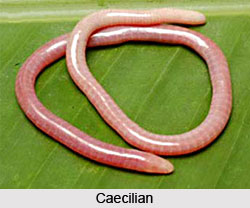
Caecilian is an amphibian which resembles snakes or earthworms and it lives mostly hidden under the ground.

Caecilian, AmphibianCaecilian is limbless, long-bodied and eel-like amphibian. The eyes are lidless, small and usually indistinct; probably a response to its essentially underground, burrowing habit. A distinctive feature of these animals is the protrudable tentacle on the side of the face located between the eyes and the nostril. The body has a series of transverse grooves within which minute scales may be found. Due to their primitive and unique characters it is presumed that caecilians arose from a different fossil group than did the frogs and salamanders.

The most prominent genera in the Indian region are Ichthyophis and Uraeotyphlus. They are distributed throughout the Indian region, being found from the hills of Sri Lanka to the Himalayas. However, they are not met with in the drier parts of their range. The largest concentrations are in the hilly regions or regions of high rainfall. The preferred habitats of these animals are in moist areas near streams and swamps.

The caecilians lay large yolked eggs, but the aquatic larva stage may or may not be present depending on the species. Some species hatch directly into a young adult. Ichthyophis provides a good example of a form with an aquatic larval stage. In Ichthyophis, the female makes a small burrow in the soil by a running stream and lays ten to twenty four eggs in it. The eggs are protected by the female who coils herself around them till they hatch. When the eggs hatch the larvae swim into the stream and from then on fend for themselves. There are no gills in the aquatic larva stage but there is a tail fin that is lost when the adult form is reached.

This article is a stub. You can enrich by adding more information to it. Send your Write Up to content@indianetzone.cominformation to it. Send your write up at content@indianetzone.com

(Last Updated on : 20/02/2010)
  More Articles in Indian Natural History
 
Indian Natural History in Mauryan Period Indian Natural History in Mughal period Indian Natural History in British Period
Indian Natural History after Independence Ants Ark Shells
Cowries Amphibians Bombay Duck
Crustaceans Algae Amoeba
Arachnids Clams Air Breathing Fishes
Sea Anemones Sea Cucumbers Sea Horse
Sea Lilies Sea Perches Sea Urchins
Scallops Slugs Small Cats
Snails Spider Sponges
Squids Mudskippers Mullets
Murrels Naticas Barnacles
Barracuda Tuna Perch
Piddocks Pomfret Mackerel
Mahseer Mantid Hydra
Loach Horn Shell Flying Fish
Cockroach Dugong, Sea Cow Garden Harvestmen
Caecilian Bristle Worm Trout
Volutes Water Spider Whelk
Termites Threadfin Thrip
Trapdoor Spider Sea Turtle Turtle
Recently Updated Articles in History of India
  • Mughal Architecture
    Mughal architecture is a combination of Islamic, Persian, Turkish and Indian architecture. It is a style that was developed under the Mughal dynasty in the sixteenth and seventeenth centuries.
  •  
  • Mansabdari System in Mughal Dynasty
    Akbar introduced the Mansabdari System in the Mughal army which primarily meant the ranking of officers on decimal system.
  •  
     
  • Deccan Policy of Mughal Dynasty
    Deccan Policy of the Mughal dynasty was weak during the reign of Babur and Humayun but after the accession of Akbar on the throne, the political situation changed and the Deccan policy was a success.
  •  
  • Coins of Pandyas
    Coins of Pandyas bear the legend of different Pandya ruler in different times.
  •  
  • Art and Architecture of Mughal Empire
    Art and architecture of Mughal Art offers an aesthetic degree to all art lovers. The subtlety of the finesse and the dazzle of the aura create huge amount of interest among tourist.
  •  
    E-mail this Article | Post a Comment
    RSS Feeds
    Forum
    Forum on Geography of India

    Free E-magazine
    Subscribe to Free
    E-Magazine on Indian Crafts
     
     
    Caecilian, Amphibian - Informative & researched article on Caecilian, Amphibian
    Sitemap
    Contact Us   |   RSS Feeds
    Copyright © 2008 Jupiter Infomedia Pvt. Ltd. All rights reserved including the right to reproduce the contents in whole or in part in any form or medium without the express written permission of Jupiter Infomedia Pvt. Ltd.