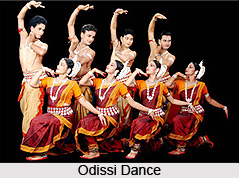
 Buddhist influence on Odissi dance was more from the Mahayana form of Buddhism. In fact the style which had been contributed to the dance form of Odisha by Mahayana Buddhism was more of a Tantric pattern. Mahayana Buddhism in embrace with Tantric idealism had its strong hold in Odisha at the Asian range of hills including Udaya Giri, Lalita Giri, Ratna Giri and Alati Giri, the Chatuspitha Parvata, representing the four celebrated pithas namely the Uddiyana, Purnagiri, Kamakshya and Srihatta. In a number of sculptural pieces of the period of Buddhist influence various human beings as well as Gods and Goddesses were found such as Marichi, Vajra, Varahi, Achala, Aparajita and Heruka represented in dance-poses which bear eloquent testimony of a particular school of dancing in ancient Odisha.
In Odhisa, the Mahayana Buddhism evolved as an intensely human ideal in socio-religious system and it presented itself in tangible form through literature, art and architecture. Therefore, dance was not a forbidden item for the monks or devotees. Attuned to the human ideal they also used to dance as a means of deliverance. It is said that dance during that time was the life-time of Lord Buddha. Therefore, it is not a surprising factor in Odishan Buddhism. Buddhist God Heruka and Goddess Nairatmya have been shown in vigorous dancing attitude in a number of sculptures found in different parts of India.
Expressions of Buddhist Dance
The Buddhist dance not only expresses the feeling of amorous love but also conveys the exhilarating sense of vigour and beauty in the attitudes of Gods and Goddesses. "Heruka" at Ratna Giri is adorned with a garland of human skulls and holds a Khatwanaga dance form with remarkable vigour; Vajra-Varahi at Choudwar holds a Vajra-tarjani and is in the Koarata dance form with intoxication displaying her nude and amorous limbs.
Marichi at Ratnagiri, Ayodhya, Khichung, Udla and Astaranga dances in alidha attitude on her chariot surrounded by dancing companions and having full set of jewellery glowing with beauty of a virgin. Ganga of Udaygiri dances in rhythmic movement conveying the sense of elegantly flowing water of the river Ganges. Aparajita at Lalit Giri dances with remarkable grace and rhythm showing tarjani in her left hand and displaying chapetadana mudra in her uplifted right hand in which she also carries a flower.
On either side of the door frame of Lalitgiri graceful figures of a dancing male and two accompanying female dancers have been engraved with mastery skill and dexterity in a square panel framed with flower wreaths. The dance indicates a peculiar style with the right leg flexed and the left foot crossing the right, the poses of the hand are in rhythmic figures, the sharp winking of the eye particularly of the female dancers and above all the jewellery, costume and the hairdo conveys a sense of romantic thrill. Similar dancing couples occur in a number of panels in the Udaygiri doorway. All these amorous couples in amorous attitude indicate consummation and enjoyment regarded as a means to deliverance in Tantrism, in the same way as asceticism or meditation in other doctrines.
Examples of this kind of dance forms may be multiplied in order to show that dancing in Buddhism had not only the aesthetic importance but also a spiritual significance.