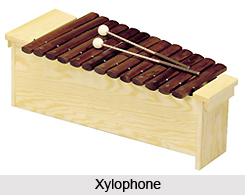
 The xylophone is a musical instrument belonging to the percussion family. It originated independently in Africa and Asia. The earliest evidence of a xylophone is from the 9th Century in Southeast Asia and there is a model of a similar hanging wood instrument, dated to ca. 2000 BC in China. The original instrument consisted of wooden bars seated on a series of hollow gourds, with the gourds generating the resonating notes that are produced on modern instruments by metal tubes. The most basic type of xylophone seen today consists of several wooden bars laid across the legs of the player and struck with wooden or plastic sticks or rubber mallets. Each bar is tuned to a specific pitch of the musical scale. The arrangement of the bars is generally from low (longer bars) to high (shorter bars). In somewhat less primitive forms, the bars are arranged on a framework.
There are many different forms of xylophone found all over the world. The most primitive forms are found in Africa. The xylophone called aso or doso in Benin is doubtless the largest xylophone in the world. The longest keys are huge, 6-foot beams. The keyboard of the big instrument is divided into two sections, one to the left of the musician and one to the right. He sits between them, resting his legs in the pit dug below the xylophone which acts as a resonator. The keys lie parallel to one another over and across the pit, which is about 28 inches deep and almost 80 inches wide. The musician strikes the left-hand keys (the bass) with a softwood club and the right-hand keys with a heavy crooked mallet made of extremely hard wood. The keyboard of the smaller instrument (doso kpevi) is set above another shallower pit. Its role is to provide a melodic and rhythmic ostinato as a cue for the main xylophone which renders the different themes designed to persuade each deity to dance at voodoo ceremonies.
Other ingenious forms are found on the islands of the Indonesian archipelago. The Thai xylophone, or rental ek, stands on a base which was often elaborately decorated and is struck with wooden mallets. In Western music, the xylophone has been extensively developed as a permanent member of the percussion section of the orchestra, though it is also played as a solo instrument. The bars are ordinarily made of a hard wood, such as teak or rosewood, and are usually rectangular in shape; but there are other shapes. They are usually slightly bowed, and somewhat hollowed out on the underside. The smallest is 5`4 inches long, the largest measures 15 inches.
The modern Western xylophone comes in two versions. The classic trapezoidal version has bars arranged in four rows on five rubber strips, but it is less common. The more usual arrangement is in two rows, so that the bars resemble a piano keyboard. The bars are struck with two or more spoon-like wooden mallets. In order to play very softly, mallets can be used whose heads are covered in rubber. The sound is sharp, but to simulate an echo, a player will often play a rapid trill. The best-known example of the xylophone played in a symphony orchestra is in Camille Saint-Saens` (1835-1931) Danse Macabre (1874).
Kasht tarang is a type of xylophone or marimba used in India. It is also called "kashth tharang". It is characterized by the use of wooden resonating bars. Unlike a xylophone, it has no resonating chambers. This instrument is not very common and is little in use.