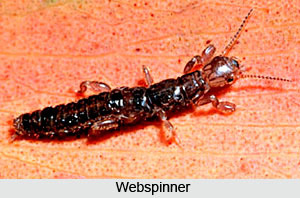
 Webspinners are primitively social insects, usually living in colonies of twenty or more individuals, and are remarkable in that males, females, and nymphs spin the silken tunnels within which they live. The silk is produced by glands located in the basal segments of the fore tarsi. The slender, elongate (six to twelve millimetre) insects are distributed mainly in the tropics and subtropics and though eight hundred species have been collected, it is estimated two thousand may actually exist. Owing to their life activity being restricted to their silken labyrinths, except for dispersal, non-specialists usually encounter only the winged males that come to lights in houses. The web spinners are also called Food spinners or Embiids.
The female web spinners are wingless and exhibit maternal care of eggs and young nymphs. They are confined to their nests, which may be in soil, under stones, under bark or lichen and in similar situations. Their food consists of bark, dead leaves, moss or lichen and is entirely of plant origin, though cannibalism is recorded. Webspinners are able to move extremely rapidly backwards into their tunnel, using their cerci as `feelers` in their reserve movement, to escape from enemies. Probably thirty five to forty Indian species are known so far, Oligotoma humbertiana being common, having spread to many parts of the world through human agency.
This article is a stub. You can enrich by adding more information to it. Send your Write Up to content@indianetzone.com