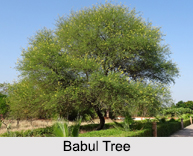
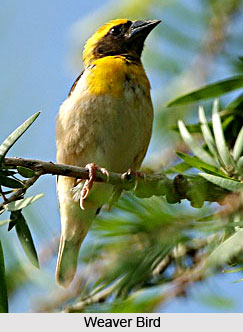
 Weaver Birds (subfamily Ploceinae), like the related House Sparrow, are characterised by a stout, conical, seed-crushing bill. The majority of species are African, only five of the species occur in Asia. Four of these, namely the common Baya (Ploceus philippinus), Finn`s Baya (P.megarhynchus), the Blackthroated (P.benghalensis) and the Streaked (P.manyar) are Indian. They are seasonally dimorphic in plumage, the breeding males being largely yellow. The commonest and most widely spread is the Baya, best known for its cleverly woven, compact resort-shaped nests suspended in colonies from palm fronds or babul (Acacia) trees, usually over water. Its breeding biology, more or less common to the other three species as well, is of special interest.
The sole nest-builder is the male weaver bird. A number of species of these birds weave their nests very finely with the help of thin filaments of leaf fibres, while some, like the buffalo-weavers, make big and untidy stick nests in their colonies having spherical woven nests within. Several males start building in company on a selected tree. There are no females present in the early stages. When the nest is half completed a party of house-hunting females arrives who move from nest to nest as if to assess the workmanship. Some nests are accepted, others rejected. The satisfied female establishes possession and is accepted by the builder as his mate. The cock thereafter completes the nest, including the long downward-facing entrance tube, while the female lays her two to three white eggs within and begins to incubate. Thereupon the cock starts building a second nest nearby, which in course of time is similarly occupied by a second hen. In this way a single cock may become possessor of three or even four nests and families in one and the same season. This type of polygamy is known as `successive polygamy` in contrast to the `harem` type of many game birds, in which a single cock holds mastery of a bevy of hens in the tradition of an oriental potentate.