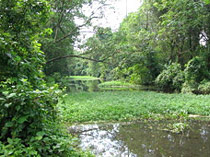
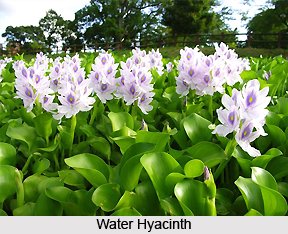
 Water plants or hydrophytes may be defined as those that spend at least a part of their life-cycle in water, completely or partially submerged. They have been classified under various categories. The floating types remain in contact with water and air only (examples are Duckweed, Water Chestnut or Singhara, Water Hyacinth, Water Lettuce and African payal, the last three being noxious weeds clogging waterways.) The Suspended hydrophytes like Bladderworts and Ceratophyllum are rootless and in contact with water only. Anchored submerged types remain in contact with soil and water either through entire life or part of it.
In Hydrilla (Jhangi) and Eel grass (Vallisneria), vegetative shoots are submerged but flowers may be at or above the water surface. Anchored hydrophytes with floating leave include the Indian Blue Water-lily (Nymphaen), and Arrowhead (Sagittaria). Emergent amphibious types have their roots, lower parts of the stem and lower leaves submerged as in Talimkhana (Hygrophila auriculata), Didhen (Aeschynomene indica) or Ludwigia. Wetland hydrophytes or halophytes are rooted in waterlooged soil at least during the early part of their life, as in certain sedges (Cyperus and Scirpus species), Khaki weed (Alternanthera sessilis), Ammania baccifera, Polygonum plebeium, Eriocaulon.
Certain plants may change their habit according to seasons. Thus Swamp Cabbage (Ipomoea asarifolia) belongs to the floating category when the water-level is high but turns into a halophyte in the dry season. The submerged plants respire and absorb grass and salts dissolved in water over their entire surface. They do not transpire because of the absence of stomata. Roots, if present, serve merely for anchorage. Woody tissue is lacking as it is not needed either for support or for conducting water from roots. The suspension in water is aided by large air-spaces in the tissues of all of the organs, which also assure the supply of Oxygen to the submerged parts.
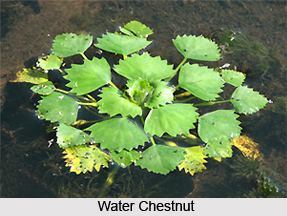
Many water plants have floating leaves. In Potamogeton and Aponogeton, the lower surface in contact with water is deprived of stomata; however, unlike in the aerial leaves, they are numerous on the upper surface so that they can take in carbon dioxide needed for photosynthesis. For preventing the stomata from getting flooded, the floating leaves usually have long stalks, their length being proportional to the level of water.
In Water Chestnut (Trapa) and Water Hyacinth (Eichhornia) the petioles are swollen, serving as floats to keep the leaf blades at the water surface. In Neptunia oleracea (Lajalu) there are spongy bladder-like swellings on the internodes. Ludwigia adscendens floats by means of white, spongy breating roots formed in whorls at the nodes. In certain Bladderworts it is the flower-stalk that bears a whorl of spongy floats. In the Eel grass (Vallisneria), female flowers are borne on a slender peduncle which exposes the flower just at the water level; later it twists in a spiral to bring the young fruits down to the mud for maturation.
Plants growing under flowing water have finely divided leaves, the advantage being that they expose a large surface for absorption of gases. In some Myriophyllum and Bladderworts, the leaf-blade is represented only by its nerves. In Salvinia (African payal), of the three leaves at each whorl, the submerged one is reduced to its nerves, functioning like a root. In the Arrowhead (Sagittaria), the leaves exposed to air are arrow-shaped, those floating are nearly cordate, whereas the submerged ones are ribbon-shaped. In Limnophila aquatica, the submerged leaves are finely laciniated whereas the floating leaves are not. In Ceratophyllum demersum it is the leafy branches that are modified as `rhizoids` to perform the functions of a root. Yet another example of a rootless aquatic is the Bladderwort, in which leaves are modified to serve as roots. Besides, leaf segments produce small bladders which capture animalcules in this remarkable insectivorous water plant.
Two families of aquatic flowering plants include the Lemnaceae, comprising the small or minute gregarious floating plants called Duckweeds. The plant body lacks distinct stems and leaves; it may be rootless or with one to many hair-like roots. Wolffia arrhiza is amongst the smallest and simplest of flowering plants, resembling small grains. The second remarkable aquatic family is the Podostemaceae, the members of which grow in rushing water and torrential hill streams. Their leaves are thin or almost nil and the stems short. The most important part of the vegetative body is formed by the roots, which are like green ribbons, resembling the thallus of algae and liverworts, sticking to the submerged rocks by hairs on their lower surface. Rich in chlorophyll, they carry out photosynthesis.