


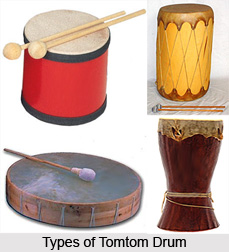
 Tomtom drum is a musical instrument of the percussion family. It comes in a variety of sizes. The smallest version is flat. The frame of the drum bulges slightly outwards and is approximately four inches high with an eight-inch diameter. It is stretched with two drumheads which are immovably fixed. Most of the tomtom drums are designed between the sizes of 6 and 20 inches in diameter, though floor tomtoms can go as large as 24 inches. Tomtom drum is a musical instrument of the percussion family. It comes in a variety of sizes. The smallest version is flat. The frame of the drum bulges slightly outwards and is approximately four inches high with an eight-inch diameter. It is stretched with two drumheads which are immovably fixed. Most of the tomtom drums are designed between the sizes of 6 and 20 inches in diameter, though floor tomtoms can go as large as 24 inches.
Origin of Tomtom It originated in China, and found its way into popular music in the 1920s. It is believed that the name came originally from the Anglo-Indian and Sinhala. The tomtom drum is also a traditional means of communication for the Native Americans. Types of Tomtom The tomtom comes in a variety of sizes. The best-known version consists of a cylindrical frame of wood laminate, about 1614 inches high and 16M inches across. The instrument stands on three feet. Two strong pieces of buckskin are stretched on individual frameworks, with which they can each be independently tuned. Unlike the snare drum, the resonating drumhead on the bottom has no resonating snares. The top drumhead is struck with drumsticks made of various materials. Another version is struck on the bottom drumhead by means of a pedal, commonly in combination with some sort of damping on the inside. The somewhat smaller version of this last tomtom is played in pairs, commonly attached to the bass drum of the drum set. The tomtom can be attached by a grommet to the bass drum of a jazz ensemble and is struck with a drumstick with a felt or leather head. The first drum kit tomtoms had no rims; the heads were tacked to the shell. As major drum manufacturers began to offer tunable tomtoms with hoops and tuning lugs, a 12" drum 8" deep became standard, mounted on the left side of the bass drum. Later, a 16" drum 16" deep mounted on three legs (a floor tom) was added. Finally, a second drum was mounted on the right of the bass drum, a 13" diameter drum 9" deep. Together with a 14" snare drum and a bass drum of varying sizes, these three made up the standard kit of five drums for most of the second half of the 20th century. Later, the mounted tomtoms, known as hanging toms or rack toms, were deepened by one inch each, these sizes being called power toms. Extra-deep hanging toms, known as cannon depth, never achieved popularity. The typical tomtom consists of a shell, chromed or plated metal hardware and head. The shell of the instrument varies according to the era of manufacture and the drum style. The shells are often constructed of 6-8 wood plies using different wood like mahogany and falkata birch. Either this or man-made materials are used, like fibreglass, acrylic, pressed steel etc. The diameter ranges from 6 to 20 inches, with heads to fit. Tomtoms can be single or double-headed. Mounting system of a tomtom is extremely important as it holds the instrument in place. Mounting systems vary greatly, from a simple cast block on the shell which accepts and clamps to a rod attached to a clamp or holder to much more sophisticated arrangements where there is no attachment to the shell, instead a frame clamps to the tuning lugs. Some drummers use a snare stand to hold a tomtom, thus making it easier to position the tomtom. |
| |||



Home > Movies & Entertainment > Indian Music > Indian Musical Instruments > Percussion Instruments > Tomtom Drum
Tomtom Drum
| Tomtom is a percussion instrument belonging to the drum family; it started getting used in popular music since the 1920s. |
| ||||||||||||||||||||||||||||

