


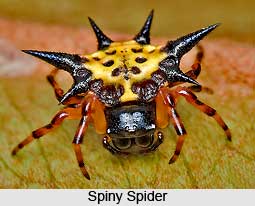
 Spiders possess a body which consists of cephalothorax (head and thoraxunited) and an abdomen, separated by a waist. The head carries eight simple eyes and along the front margin a pair each of jaws (chelicerae) with foldable poison fangs and pedipalps which are six-jointed. On either side of the thorax there are four seven-jointed legs, the size and disposition of which vary greatly in different genera. At the hind end of the abdomen are four or six spinning organs. The spider has an alimentary canal with a sucking stomach. The heart is tubular. Respiration is by air tubes or book-lungs. Spiders possess a body which consists of cephalothorax (head and thoraxunited) and an abdomen, separated by a waist. The head carries eight simple eyes and along the front margin a pair each of jaws (chelicerae) with foldable poison fangs and pedipalps which are six-jointed. On either side of the thorax there are four seven-jointed legs, the size and disposition of which vary greatly in different genera. At the hind end of the abdomen are four or six spinning organs. The spider has an alimentary canal with a sucking stomach. The heart is tubular. Respiration is by air tubes or book-lungs.
The peculiarity of spiders is their ability to spin. Silk is a part and parcel of their life. They are born in silk, their webs and cocoons are of silk, they capture their prey with silk and they dangle and travel by silk threads. All spiders therefore are born with spinning organs and silk glands. The spinning organs are the four or six teat-like spinnerets at the hind end of their body. Each teat is not a single tap but carries numerous apertures connected with the various silk glands within. The spider can draw silk from the glands in whatever quantity or quality is required for a particular work. The animal by holding the spinnerets together can join threads, or by holding the tips a little apart manufacture broad bands of silk for swathing struggling victims. Besides the spinnerets, additional spinning organs such as a sieve-plate under the belly (cribellum) or a comb of hairs along one pair of legs (calamistrum), are possessed by some spiders )i.e. Eresids). Nature has provided a spider with silk glands capable of yielding silk for as long as it lives. Within the glands the silk is in a fluid condition. It is drawn and emitted out in fine streams through the minute taplets or apertures. The fluid silk solidifies on coming into contact with air. The spider has no power to shoot out silk to any distance. After emitting a drop of liquid silk the spider pulls it with its spinnerets to make it into a thread. In paying out threads to the air the breeze serves as the pulling force. The sphincters of the spinnerets are weak and the escape of silk from its belly is not rigidly controlled by the spider. Taking advantage of this fact naturalists have been able to draw, by winding, more than hundred metres of thread from a single spider in one hour. 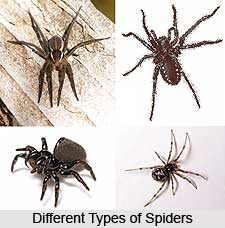 The spinning powers of spiders vary greatly. It is in Obr-Weavers that we find the maximum number and variety of silk glands. The typical orb-weaver - Araneus - has six hundred silk glands of five different sets occupying the entire floor area of her belly. Each set has a technical name and is used for a particular work. Thus the silk from the ambullaceal set is used for boundary lines and spokes, aggregate for viscid spirals, tubuliform for cocoons, aciniform for anchoring and piriform for winding and enwrapping prey.
Spiders are widely distributed throughout temperate and tropical regions. They are ubiquitous and thrive in all environments. They vary greatly in size, shape and habits. There are Sedentary and Roving spiders. The Sedentary spiders include; Orb-weavers (Argyopids), Irregular Line Web-weavers (Pholcids, Theridiids etc.), Nest-weavers (Eresids), Water spiders (Lycosids). The Roving spiders include; Hunters (Lycosids, Sparassids, Oxyopids, Thomisids, etc.), Jumpers (Attids). Most of the sedentary and roving spiders are solitary. Some Theridiids, Pholcids and line-weavers are gregarious, i.e. they build their independent webs contiguous to each other. A few of them weave webs generally on the periphery of an Argyopid web and poach the insects caught in its snare and even attack and eat the Argyopid. The only truly social spiders are the Eresids which build a huge common nest and live inside it. All spiders feed chiefly on insects. Web-weavers eat the insects caught in their snares. Underground tube dwellers prey on insects coming near prey and eat them. Spiders are gluttons. They can eat a large number of insects at a time. They can also starve for a long period - some for nearly eighteen months. In the spider kingdom females are dominant. Males are generally pygmies and dull-coloured. In general such as Argyope and Nephila the disparity is very great. A female Nephila is in length twenty times and in weight thousand times the male. The mature males of web-weavers are nomadic, wandering in search of females. During the mating season they appear in large numbers along the borders of female webs, sometimes weaving rudimentary webs. Their only mission is to fertilize the female - and die during or soon after mating. In Nephila and allied genera the mating operation is fraught with considerable danger to the males. If the female is hungry even the most cautious approach of the male will result in his being eaten. If she is not hungry she may accept him but if he is not quick in escaping she is sure to devour him. The life of the males therefore is generally short. Females live longer - they have to lay eggs, protect them and nurse the spiderlings until the young can live by themselves. The pregnant female weaves a silk matlet, lays her eggs on it and winds it into a cocoon. The size, shape and colour of cocoons differ in different genera. Cocoons of garden Spiders are nearly spherical, yellow or white and attached to one side of their webs. Cocoons of Cyrtophora, whose web resembles an umbrella, are ovoid and green, attached vertically above the web like a beaded chain. Lycosids and Pholcids have small globular cocoons which they carry by their spinnerets or jaws. The common Indian House Spider Heteropoda venatoria and other Sparassids have round, flat, disc-like cocoons which they carry beneath their belly. Others have cocoons of varying shapes which they conceal under patchy sheets in crevices of walls, bark of trees, axils of leaves, bunch of fruit, etc. A cocoon of Araneus contains six hundred eggs; of Argyope twelve hundred to two thousand; line-weavers 100 and Attids only two to four eggs. The eggs hatch producing spiderlings. Fresh spiderlings cannot feed or spin. They become active only after one or two moults (casting of the skin). The mother spiders are ready to avoid food and risk their own lives to protect the eggs. Some even carry the spiderlings on their backs until the young ones are able to live independently. When once independent, each spiderling sets off by air into the unknown. This occurs in spring or early autumn when the wing is gentle. The spiderlings sit on any raised convenient spot with head lowered and abdomen raised. In this position they emit silk which becomes threads. As the threads begin to float in the air the spiderlings leave their holds, cling to the thread and sail in the air. Although the direction of their flight will be determined by the wind, the spiderlings can land where they choose by hauling in the threads and rolling them into a ball. By this 'gossamer' method spiderlings cross wide rivers and oceans and are carried to considerable heights. Aeroplanes frequently run into gossamer. Scorpions, lizards, birds, frogs, toads, insectivorous mammals - all feed on spiders and their cocoons. Solitary wasps and ichneumon flies particularly hunt them and store them in their cellars for the sustenance of their young. Within houses their cobwebs are brushed away by housewives. Digging, ploughing and tree felling also destroy spiders. Sedentary spiders have their webs, nests or tubes which adequately shelter them from their enemies, besides enabling them to catch their prey. Roving spiders have strong and nimble legs armed with sharp spines. Some can make long and sudden leaps. Others can move zigzag like flies or sideways like crabs. Some mimic inedible insects such as ants and ladybirds or floral stamens and birds' droppings. Some are coloured in harmony with their surroundings and some can change their colour to suit the environment. Some have long and cylindrical bodies and long, thin legs (Tetragnatha) which they can stretch far apart and remain concealed along twigs and leaf-blades. Argyope and Nephila have warning colours. Gasteracantha imitates woody knots. Pholcids oscillate their webs and make spasmodic up-and-down movements of their bodies so rapidly that enemies leave them alone. Some sham death when disturbed, drop down and scurry away unnoticed. Generally speaking spiders are harmless to man except one or two species of the genus Poecilotheria. Spiders feed on mosquitoes, flies and cockroaches within the houses. Outside they are the principal agency that controls the bewildering multiplication of insects which destroy vegetation and crops. |
| |||



Spider
| Spider is an insect that possess eight legs and are air-breathing chelicerate arthropods and the chelicerae are modified to become fangs which injects venom. They are found all over the world. |
| ||||||||||||||||||||||||||||

