


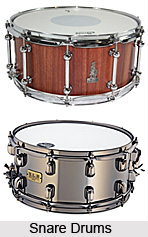
 The snare drum belongs to the family of double-headed cylindrical drums. It is a percussion most often seen in the symphony orchestra, jazz, and the world of popular music. This percussion instrument is also often called the side drum as initially it used to be attached to the waist of the player and played on the side. The snare drum belongs to the family of double-headed cylindrical drums. It is a percussion most often seen in the symphony orchestra, jazz, and the world of popular music. This percussion instrument is also often called the side drum as initially it used to be attached to the waist of the player and played on the side.
History of Snare Drum It is believed that the snare drum has descended from a medieval drum called the Tabor. Tabor was a drum with a single gut snare strung across its bottom. It was first used in war, often played with a fife or pipe. Snare drum gained popularity with the Swiss mercenary troops around the 15th-16th century. This musical instrument underwent changes several times in the past to improve its design and sound. And eventually, in the modern days it is used in pop music and orchestral music. Design and Construction of Snare Drum The snare drum has a cylinder-shaped frame, usually made of laminated wood or brass. The snare drum is carried on the hip on a leather strap. As its name implies, the snare drum includes strings or snares. A number of snares made of gut, nylon, curled metal wire, metal cable or plastic cable are stretched over the bottom drumhead. The purpose of this is to give extra sharpness to the sound. The snare drum is struck with two thin wooden drumsticks, 15 inches long, which narrow toward the end, finishing in a bullet-shaped tip. The snare is also referred to as the military drums. Marching snare drums are deeper in size than snare drums normally used for orchestral or drum kit purposes, often measuring in at a foot long. Pipe, tabor, and some military snare drums often have a second set of snares on the bottom (internal) side of the top (batter) head to make a "brighter" sound, and the Brazilian caixa commonly has snares on the top of the upper drumhead. Types of Snare Drum The snare comes in various sizes. When used in music being played for the symphony, the frame of the drum, which in fact determines its whole size about 6-8 inches high and has a diameter of about 14 inches. In the case of popular music, the size is similar, but the frame is significantly shallower, about 4 inches. Where marching and brass bands are concerned, the snare drum has a height of 61/2 inches and a diameter of 15 inches. Orchestral and drum set snare drum shells are about 6 inches deep. Piccolo snare drums are even shallower at about 3 inches deep. Soprano, popcorn, and firecracker snare drums have diameters as small as 8 inches and are often used for higher-pitched special effect Playing of Snare Drum The snare drum can be played in a number of ways. It can be struck with a beater, which includes rutes and brushes, which produce a softer-sounding vibration from the wires. While using the stick, the head of the drum, the shell or the rim may be struck by the drummer. When the top head is struck the snares vibrate against the bottom head producing a cracking sound. The snares can often be thrown off with a lever on the strainer so that the drum only produces a sound similar to a tom-tom. A particular technique associated with snare drums is that of Rim shots. Here, the head and rim are struck simultaneously with one stick. In concerts, a stick placed on the head and rim is struck by the opposite stick. Another common term associated with snare drums is rudiments, which are sets of basic patterns often played on a snare drum. Usage of Snare Drum The snare drum is considered one of the most important drums of the drum kit. In the present days, in popular music, especially with rock drum kits, the snare drum is typically used to play a backbeat pattern such as quarter notes on the backbeat or the slightly more interesting. The most striking example of the use of the snare drum is in Ravel's Bolero (1928). |
| |||



Home > Movies & Entertainment > Indian Music > Indian Musical Instruments > Percussion Instruments > Snare Drum
Snare Drum
| Snare drum is a double headed cylindrical drum often seen in the symphony orchestra, jazz, and the world of popular music |
| ||||||||||||||||||||||||||||

