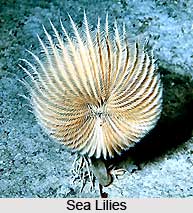
 Sea Lilies or Feather Stars are echinoderms looking like shootlets of a fir tree. They are allies of starfish with a central pentangular disc and very long radiating arms. Although they can swim freely they prefer to remain fixed to rocks or weeds at the sea bottom. In this mode of life they have their mouth or oral side turned upwards and they fix their back to the mud by certain claw-like growths. Their anus is on the oral side. Each of the five rams is divided into two and in each branch there are rows of filamental growths giving a plume-like appearance. The arms are grooved longitudinally and are lined with tiny tube-feet. These tube-feet however are without ampullas and are not used for walking. They serve as respiratory organs.
Sea lilies feed on minute sea organisms which are shifted towards the mouth by the cilia fringing the pores of the arms. The skeletons of sea lilies are of calcareous plates without spines.
The free-swimming larva of a feather star is a curious little, oval jelly which swims freely by cilia. During the swimming stage, which lasts for many days, lime plates are formed which arrange themselves in a cup form. A stalk is also formed. The jelly body becomes absorbed and the larva sinks to the bottom and gets fixed to some track. Here it becomes transformed into a sea lily which grows into an adult.
Sea lilies are generally brilliantly coloured. Very many gigantic and beautiful species of stalked feather stars lived in the deep sea during the Palaeozoic era but most of them have vanished. Now there are only some genera in the world distributed at varying depths.
Two interesting species, Tropiometre eucrinus and Imprometra palmate, are common on Indian shores: The former is a graceful purplish creature with ten plumete arms; the latter has 30 to 40 arms.
This article is a stub. You can enrich by adding more information to it. Send your Write Up to content@indianetzone.com