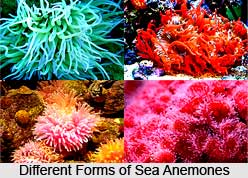
 Sea Anemones are sedentary coelenterates resembling hydras but stouter and larger. They are solitary and rarely form colonies. In internal structure they are far more advanced than hydras and Obelias. With their numerous spreading tentacles fringed with hair-like cilia and tinged white, lilac, yellow or orange and their habitat on mud banks and rock pools, sea anemones form conspicuous objects of the seashore. Many of them however shroud their bodies with sand grains and shingle and when exposed during low tides they shrink to such insignificant masses that they are often overlooked.
A typical sea anemone has a cylindrical body with an adhesive basal disc at the attached end and an oral disc with a slit-like mouth in its centre at the free end. The tentacles are hollow and their number varies from six to many arranged in circlets about the mouth. In one species, Actinia equine, there are one hundred and ninety two tentacles arranged in six circlets of 6, 6, 12, 24, 48 and 96. All tentacles bear stinging cells and are highly contractile. They can expand or contract considerably, capture prey and convey the food to the mouth. The animal can voluntarily shift its position by softly sliding its basal disc. The gastro vascular cavity of the sea anemone is not simple. The slit-like mouth does not lead directly into the cavity but through a tube or gullet which is not circular but compressed from side to side. This gullet has two ciliated grooves one on either side. A constant stream of water enters into the body cavity through these grooves and supplies the animal with oxygen.
There are male and female sea anemones producing either sperms or ova. The sperms are discharged into the gastric cavity from where they escape through the mouth. They are then carried partly by the action of their cilia into the cavity of a female where they fertilize the ova. The fertilized ovum divides and becomes an elongate ciliated larva. In this condition the larva leaves the parental cavity, swims for some time and settles on a suitable support where it develops into a fresh sea anemone.
The distribution of sea anemones is wide and many typical genera are found along all the sea coasts. They abound in tidal pools, and reefs have a rich representation of large and colourful anemones. There are many interesting forms and the tropical ones are the more brilliantly coloured.
Metridium is a typical sea anemone found fixed to some solid object along the seashore where rock pools and mud banks abound. It has a dark brown trunk about eight centimetres high and white, hollow tapering tentacles fringed with rich clusters of cilia. Delicately coloured Sagartia, about 2.5 to 3 centimetres high, is common on rocks. Adamsia is a stout reddish sea anemone with grey tentacles found fixed on the back of empty gastropod shells inhabited by hermit crabs. It has the benefit of being carried from place to place by the crab whereas the latter gets protection from predacious fishes which avoid the stinging weapons of the sea anemone. Members of the genus allied to Cibrina measuring about five centimetres in diameter and six to eight centimetres in height, bluish in colour with numerous slender tentacles and vertical rows of warty growths on the column, are found on mud-covered rocks. When they are exposed during low tide they contrast and appear to be mere greyish lumps. These sea anemones owe their green colour to the presence of algae in their cells. Zoanthus is another example where the original polyp sends out a horizontal branch (stolon) from which new polyps are formed by budding. Sphenopus is a somewhat flattened darkish sea anemone three to six centimetres long, usually broad and triangular at one end and narrow and cylindrical at the other. Its outer layer is tough, coated with sand grains. In life the animal anchors in mud by the broader triangular end, exposing its tentacle-covered disc at the free end. Angry waves uproot these anemones and throw them to the shore as ugly lumps of jelly. But if returned to the sea they anchor again and expand vertically, exhibiting the disc and tentacles.