


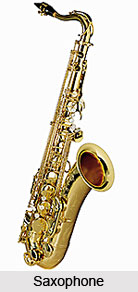
 The saxophone is a modern, single-reed, wind instrument that is made of brass. It is named for its inventor, the Belgian instrument-maker Adolphe Sax (1814-1894). The saxophone is a conical-bored transposing musical instrument considered a member of the woodwind family. Saxophones are usually played with a single-reed mouthpiece similar to that of the clarinet. The saxophone is a modern, single-reed, wind instrument that is made of brass. It is named for its inventor, the Belgian instrument-maker Adolphe Sax (1814-1894). The saxophone is a conical-bored transposing musical instrument considered a member of the woodwind family. Saxophones are usually played with a single-reed mouthpiece similar to that of the clarinet.
Most saxophones are made of brass. Still, they are categorized as woodwind instruments because the sound waves are produced by an oscillating reed, not the player's lips against a mouthpiece as in a brass instrument, and because different pitches are produced by opening and closing keys. The saxophone consists of a wide conical metal tube that is generally bent at the opposite end to the mouthpiece. The most unusual feature of this instrument is certainly the mouthpiece. The use of different materials for the mouthpiece creates different tone colours. The strength and quality of the reed can also change the timbre. Professionals generally choose a mouthpiece based on their style or on the piece to be played. At intervals along the tube are between 20 and 23 tone holes of varying size, including two very small 'speaker' holes to assist the playing of the upper register. These holes are covered by keys (also known as pad cups), containing soft leather pads, which are closed to produce an airtight seal; at rest some of the holes stand open and others are closed. The keys are controlled by buttons pressed by the fingers, while the right thumb sits under a thumb rest to help keep the saxophone balanced. Saxophone fingerings are like the oboe's, the mouthpiece is like the clarinet's (blown with a single reed). The timbre lies somewhere between that of a woodwind instrument and that of a brass instrument, and ranges from the mellowness of a flute to the metallic forcefulness of a cornet. The saxophone has a single reed mouthpiece similar to that of the clarinet. The simplest design of saxophone is a straight conical tube, and the sopranino and soprano saxophones are usually of this straight design. However, the largest instruments usually incorporate a U-bend slightly above the lowest tone hole. This U-shape has become an iconic feature of the saxophone family, to the extent that soprano and even sopranino saxes are sometimes made in the curved style even though this is not strictly necessary. By contrast, tenors and even baritones have occasionally been made in the straight style. Most commonly, however, the alto and tenor saxophones incorporate a curved 'crook' above the highest tone hole but below the top speaker hole, tilting the mouthpiece through 90 degrees; the baritone, bass and contrabass extend the length of the bore mainly by double-folding this section. The saxophone was accorded an important role in opera, military and chamber music initially. While proving very popular in its intended niche of military band music, the saxophone is most commonly associated with popular music, big band music, blues, early rock and roll and particularly jazz. There is also a substantial repertoire of concert music in the classical idiom for the members of the saxophone family. Saxophone players are called saxophonists. The saxophone is primarily known as a popular music and jazz instrument. The saxophone is widely used in the Indian music scenario. Most prominently, it is used in the performance of Carnatic music. Some modifications however needed to be made to it before it could completely conform to the needs of Indian classical music. Musicians are known to have replaced the rigid metallic connecting rods which operate the keys with elastic rubber strings. Also, the leather pads at the bottom of the keys which open/close the holes have been replaced by felt pads with a convex surface. Apart from this, the saxophone is also used for a number of different genres of music such as popular albums, instrumental music and even for the music of Hindi films. |
| |||



Home > Movies & Entertainment > Indian Music > Indian Musical Instruments > Wind Instruments > Saxophone Music Instrument
Saxophone Music Instrument
| Saxophone is a modern wind instrument which is popularly used in jazz music; in India it is employed for the purposes of Carnatic music. |
| ||||||||||||||||||||||||||||

