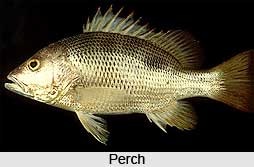
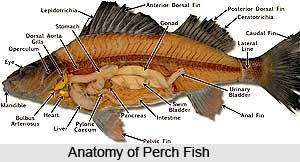
 Perch (suborder Percoidei) are a very large group of fishes, with thirty five families in Indian waters, using most of the ecological niches in the aquatic kingdom. They have a single long dorsal fin, the front part of which has pointed spines and the hind part soft, jointed fin-rays. In some cases these parts are separate, indicating two fins. Although a large number are marine, a few freshwater and some estuarine species are also found in this group. Among freshwater species, the tiniest measure about six centimetres when fully grown. Their body tissues being transparent and bones being visible, they are called `glass fish` or the `X-ray fish` and are admired as good aquarium fish. Eggs are laid in aquatic weeds and hatch out into larvae within twenty four hours. They are commonly found in most of the rivers of India. The next member of this group, in size, is Toxotes. Two more species of perch-like fishes occurring in fresh water are Badis badis and nandus nandus of the family nandidae. Both these are bottom-dwelling forms found mostly in perennial ponds and lakes of north-eastern India.
Badis is a small, eight centimetres long fish, known for its ability to change colour according to its surroundings, like a chameleon, from light green through purple and bluish black to dark stripes on the body, as camouflage do avoid being seen and caught. It is accepted as a aquarium fish though considered rather mischevious in a community tank. Being carnivorous in habit, it takes fish larvae, worms, Daphnia, Cyclops and other organic matter at the bottom. Eggs are laid on the underside of inverted tiles or any other broken earthen ware and guarded by the male. Nandus nandus lives in similar habitat nad has the same habits as the Badis; but it is different in colour, having unchangeable irregular black and white oblique stripes. It is slightly larger than Badis and is not welcome in home aquaria.
 Among the estuarine perches, Lates calcarifer is undisputedly the most popular food fish in the Indian subcontinent and is also a game fish. It is known as beckti or begti in north-eastern India. When grown up, its full size is from one to seven metres, it is bluish olive in colour but when about two centimetres long, it has black and white irregularly oblique stripes. When juvenile (twenty centimetres) it has sometimes cloudy vertically disposed blotches. Adults are found near the mouths of creeks and breed early in the monsoon. Young ones frequent flooded salt-pits, low-laying puddles or ricefields in search of their favourite items of food such as prawns, crabs, small fish and other aquatic organisms and grow fast if food is plentiful. They are solitary in habit.
Another estuarine perch is the `target perch` so called because of the slightly concentric dark bands on its body and a round blotch on the dorsal fin, similar to the bull`s eye of a shooting target. It is Terapon jarbua, the commonest of the four species of the genus and only fifteen centimetres long when full grown. T.theraps has parallel bands, instead of concentric, and is found in offshore water. As a group they are also known as `squeaking perches`. T.jabura is very active both in the aquarium and in the field and subsists on prawns, larvae and the young of other fish, crabs, worms and other aquatic forms of life. It breeds in the estuaries and the young ones spread into smaller streams all round.
Seatophagus argus and Sillago sihama, two other estuarine perches, are both non-carnivorous. The first feeds largely on rooted aquatic plants, has a blunt mouth with brownish teeth, and an almost oblong body with large dark blue spots. Young ones are orbicular and more colourful, with reddish stripes added to the spots. They can be easily acclimatized to fresh water and utilized as beautiful aquarium fish. Known as `scats`, they have never been bred in aquarium tanks so far and fetch a good price abroad.
Sillago, lady-fish or sand-whiting, is a food fish on the west coast of India. It has an elongated sleek and slender body, tapering head and terminal mouth, well adapted for picking up polychaete worms from the bottom ooze, other benthic organisms and, at times, soft weeds and filamentous algae. Olive-green along the back, becoming light green on the sides and abdomen, it measures at most twenty eight centimetres at the end of the fourth year of its life. It breeds in estuarine waters, the spawning season extending from the month of August to September. Being a prized fish in the market and non-predatory, its fingerlings are much valued in coastal aquaculture.